
Menu
MOLYBDENUM · TUNGSTEN · ALLOY STOCK & CUSTOM PARTS
Specify the Mo:W ratio, product form and finished dimensions for your component. MetalsTek lists Mo-W rod, bar, sheet, plate, disc and crucible options, with custom proportions and shapes reviewed against your requirements.
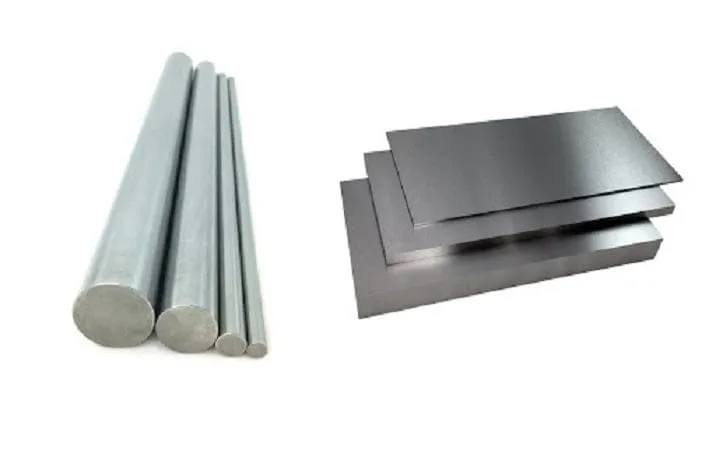
Existing MetalsTek catalogue image of rod and flat-product forms. The selected composition and dimensions are confirmed during quotation.
State the cross-section, diameter or section dimensions, length, material condition and any machining allowance.
Provide thickness, width, length, flatness, surface and the selected Mo:W ratio. Define the delivery condition where it matters.
Include diameter, thickness, surface and dimensional tolerances. A drawing helps define the finished disc requirements.
Send a dimensioned drawing, composition, quantity and operating environment for a geometry-specific review.
| Parameter | Published option / enquiry requirement |
|---|---|
| Material | Molybdenum tungsten alloy (Mo-W). |
| Featured catalogue composition | Molybdenum 70%, tungsten 30%. The percentage basis is not stated in the existing catalogue and must be defined for the order. |
| Other listed Mo:W ratios | 50:50 and 80:20; custom proportions can be submitted for review. State the element order and whether percentages are by mass or atomic fraction. |
| Published forms | Rod, bar, sheet, plate, disc and crucible; other shapes by drawing review. |
| Dimensions | Custom sizes; provide actual dimensions, tolerances, surface and material condition. No universal size envelope is stated on the current page. |
| Chemistry and documents | Define composition tolerances, impurity limits, sampling / test requirements and documentation for the selected material. |
The entries above describe catalogue options, not measured batch results. The inherited composition and density tables are retained below for review, with unresolved source fields identified explicitly.
This table is retained from the existing catalogue, including its original field text. The percentage basis and acceptance limits must be confirmed before ordering. These entries are not a certificate or a batch analysis.
Type | Content % | Impurity less than% | |||||||||
Mo | W | Total impurity | Fe | Ni | Cr | Ca | Si | O | C | S | |
MoW50 | 50±l | Rest | <0.07 | 0.005 | 0.003 | 0.003 | 0.002 | 0.002 | 0*05 | 0.003 | 0.002 |
MoW30 | 70±1 | Rest | <0.07 | 0.005 | 0.003 | 0.003 | 0.002 | 0.002 | 0.005 | 0.003 | 0.002 |
MoW20 | 80±1 | Rest | <0.07 | 0.005 | 0.003 | 0.003 | 0.002 | 0.002 | 0.005 | 0.003 | 0.002 |
Source fields requiring clarification: MoW50 lists Mo as “50±l” and oxygen as “0*05”. These have not been silently converted into numerical limits. Confirm the intended values, the Mo/W naming convention and each impurity limit in the quotation.
The existing catalogue lists these density ranges without a measurement method, material condition or porosity information. They are preserved as source reference values, not theoretical alloy densities, batch measurements or guaranteed acceptance criteria.
Type | Density g/ cm3 |
MoW50 | 12.0—12.6 |
MoW30 | 10.3 — 11.4 |
MoW20 | 10.5〜11.0 |
Specify the required density and test method for the selected composition and product condition if density is an acceptance requirement.
Define the Mo:W ratio and percentage basis, chemical tolerances, material condition, finished geometry and required documents. The existing page does not establish a manufacturing route, mechanical-property guarantee or inspection programme for every custom part.
If a material standard is required, name its edition and the clauses applicable to the ordered product form. Agree dimensional inspection, chemical verification and any additional testing during quotation.
For furnace or other thermal components, state temperature, atmosphere, loading and thermal cycle. A high melting point alone does not establish allowable service temperature, oxidation resistance or component life.
For molten-metal contact or another chemically demanding process, include the medium, composition, contact conditions and required acceptance evidence. The alloy name alone does not establish corrosion performance or suitability for regulated service.
For furnace, thermal or electrical components, include the drawing revision, mating dimensions, material condition and operating environment. Review suitability against the actual component requirements.
Mo-W products are identified and protectively packed for storage and transport. Confirm identification, packing quantity, surface protection, handling and documentation with the order.
The current catalogue features Mo 70% / W 30% and also lists Mo:W 50:50 and 80:20. Other proportions can be submitted for review. State the percentage basis and allowable composition tolerance explicitly.
The page lists rod, bar, sheet, plate, disc and crucible options. Send a drawing for another shape and confirm the composition, dimensions, tolerances, surface and material condition during quotation.
No batch test data are supplied on this page. The inherited tables are catalogue references. Some source fields are ambiguous and the density ranges lack a stated method and material condition. Agree acceptance values and documentation for the order.
No universal service limit is stated. Provide the temperature, atmosphere, loading, thermal cycle and contact medium for review. Composition and product form alone do not establish suitability for a particular process.
Send Mo and W percentages with their basis, required form, finished dimensions, tolerances, quantity, surface, material condition, drawing and any chemistry, inspection or documentation requirements.
Review common Mo, Mo-1, Mo-2, TZM and Mo-La terminology as background when defining a material specification. It does not replace the agreed Mo-W chemistry.
See where refractory-metal parts fit within furnace and crystal-growth equipment, then define the actual geometry and operating conditions for your component.
Send the Mo:W ratio and percentage basis, product form, dimensions, tolerances and quantity. Include the drawing, material condition, operating environment and required documents.