
Menu
Compare niobium tube and pipe, fine capillary tubing and ring blanks. Specify grade, OD, ID or wall thickness, length and tolerances; include a drawing for a dimension-specific quotation.
Niobium Materials / Tubes, Capillaries & Rings
Select tube/pipe for a specified bore and length, capillary for fine-bore requirements, or a ring/tubular blank for axial-height and end-face requirements. The three existing listings below retain their dimensional references. Exact combinations, condition and availability require quotation review.
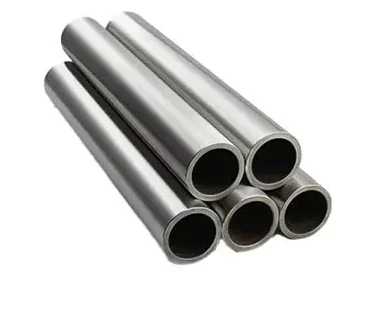
Confirm seamless or welded construction, OD/ID or wall, straightness, ovality and end finish for the actual geometry. Density 8.57 g/cm³ is a niobium reference, not an alloy/porosity-specific acceptance value.
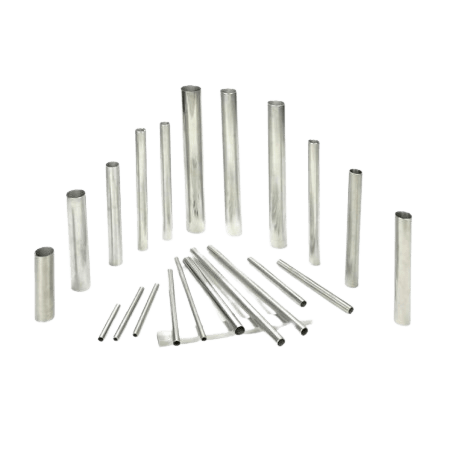
These separate ranges do not establish every combination. For a concentric round tube, ID = OD − 2 × wall thickness and must remain positive. Fine-bore and thin-wall tolerances need explicit supplier agreement; no uniform precision or medical approval is implied. Density reference: 8.57 g/cm³.
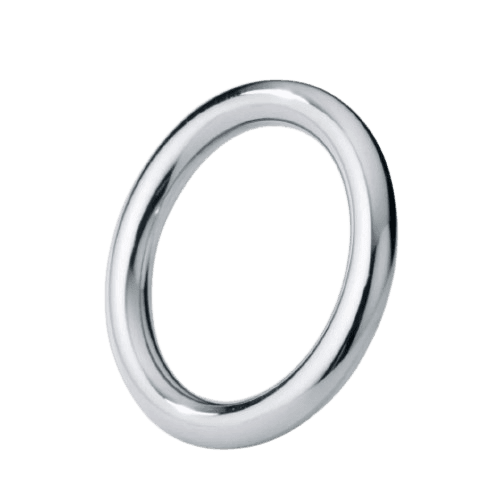
Ranges are separate inquiry references, not a guarantee of every size combination. ASTM B394 is a tube standard; it does not automatically certify a finished machined ring. Agree starting-material requirements and finished-part inspection separately. Application descriptions do not establish nuclear, aerospace, pharmaceutical or implant certification.
ASTM B394-18 covers wrought niobium/alloy seamless and welded tubes. It identifies R04200 as Type 1 reactor-grade unalloyed Nb and R04210 as Type 2 commercial-grade unalloyed Nb. These names do not establish a supplier’s nuclear qualification or medical approval.
Specify the edition, grade, construction, condition, dimensions, inspection and required reports. Small-OD/thin-wall tolerances require producer agreement; the standard’s ordinary tube tolerances should not be transferred blindly to fine capillaries. Ring geometry and finished-part acceptance need separate drawing requirements.
Existing supplier reference chemistry (mass % maxima; Nb balance): retained below for inquiry comparison. This historical table is not reproduced ASTM B394 acceptance chemistry: several impurity limits differ. Confirm the offered grade, complete chemistry and test report against the specified standard/edition; a total-purity percentage alone cannot establish R04200 or R04210 conformity.
| Grade | Nb | Fe | Si | Ni | W | Mo | Ti | Ta | O | C | H | N |
|---|---|---|---|---|---|---|---|---|---|---|---|---|
| R04200 | Balance | 0.004 | 0.004 | 0.002 | 0.005 | 0.005 | 0.002 | 0.07 | 0.015 | 0.004 | 0.0015 | 0.003 |
| R04210 | Balance | 0.01 | 0.01 | 0.005 | 0.02 | 0.01 | 0.004 | 0.1 | 0.02 | 0.01 | 0.0015 | 0.01 |
Do not treat these supplier reference limits as proof of certification or automatically apply them to Nb–Zr alloy. If standard compliance is required, the agreed standard and actual material certificate govern.
Existing mechanical reference: the original tensile/yield/elongation entries and thickness break are retained below. Their original specimen/condition evidence is not independently established here; confirm annealing condition, test method, specimen orientation and the relevant thickness or wall basis for the offered product. These are not blanket minima for all cold-worked capillaries or machined rings.
| Grade | Tensile strength, psi (MPa), ≥ | Yield strength (0.2% offset), psi (MPa),≥ | Elongation in 1″ gage length, %, ≥ | |
|---|---|---|---|---|
| >=0.010” | <0.010” | |||
| R04200, R04210 | 18000 (125) | 10500 (73) | 20 | 15 |
For round tubing, define any two controlling dimensions among OD, ID and wall, plus the tolerances needed to derive the third. Identify measurement locations, eccentricity/concentricity, ovality, straightness, length and end squareness or burr limits. A drawing is particularly important for capillaries and finished rings.
Specify the application, temperature, atmosphere, pressure or vacuum, chemical exposure and cleanliness requirements. Niobium’s melting point or a generic corrosion claim does not set a service rating. Nuclear/medical use and sensitive processes need separately verified material, inspection and qualification requirements; ordinary tube data is insufficient.
Existing products are externally tagged for identification and protected against transport/storage damage. For fine tubing, request the required bore/end protection, cleanliness, separation and label/documentation requirements for confirmation.
Send: Material Grade, purity/chemistry, OD, ID or Wall Thickness, Length/axial height, Tolerance, Quantity, Application and Drawing revision. Identify seamless/welded and material condition where required. Quote buttons reuse the existing mechanism to prefill the product context in Project Details; complete the Product / Material field and attach the drawing below.
Start with the Niobium Hub; compare Tantalum Tubing for a separately assessed material choice, or send a drawn ring/component to Precision Metal Machining Services. Material choice does not imply identical properties or tolerances.
Other existing tube routes: Tungsten · Zirconium · Titanium · Hafnium · Molybdenum · Chromium · Nickel.
No. ID must be positive, and size combinations, length, condition and dimensional tolerances must be agreed for the actual product.
No. It is a material designation. Qualification, traceability, inspection and application approval require separate evidence and agreement.
No. It concerns tube products. Define starting material and finished ring dimensions, finish and inspection on the drawing.