
Menu
MOLYBDENUM · ALLOYS · COMPOUNDS
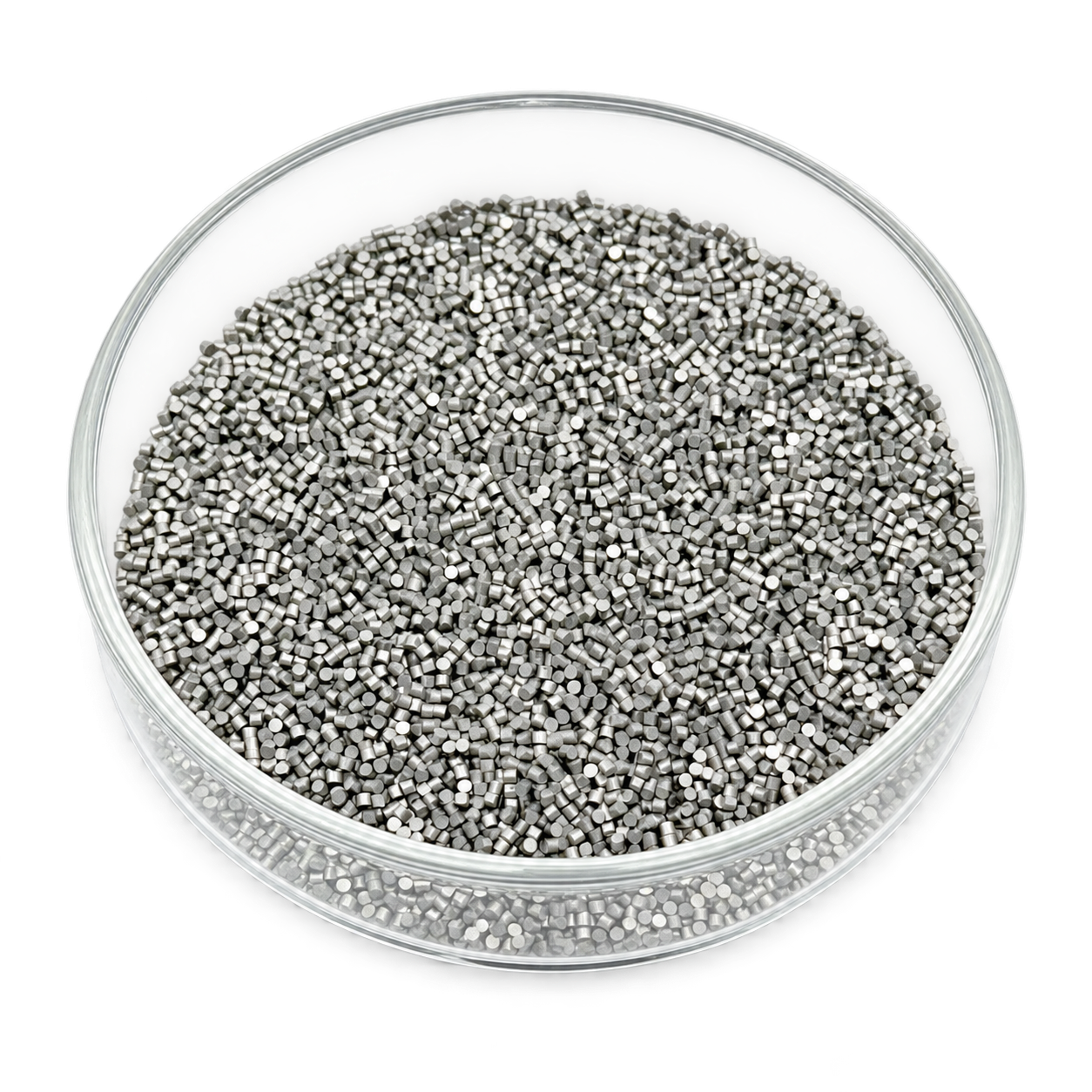
Choose elemental molybdenum, Mo-based alloys or compounds for your thin-film deposition project. Request pellets, granules, powders or a custom source geometry matched to your equipment.
11 material options · Grade-specific specifications · Custom dimensions on request
Compare the material identity, available forms and catalogue purity range below. For alloys, include the required Mo-to-alloying-element ratio. Final availability and acceptance criteria are agreed during quotation.

Catalogue purity: 99.9–99.99%
Forms: Powder, pellets, granules and custom shapes

Catalogue purity: 99.9–99.99%
Forms: Powder, pellets, granules and custom shapes

Catalogue purity: 99.9–99.99%
Forms: Pellets, granules and custom shapes

Catalogue purity: 99–99.9%
Forms: Pellets, granules and custom shapes

Catalogue purity: 99–99.9%
Forms: Pellets, granules and custom shapes

Material: MoS₂
Specify the required form, dimensions and purity. Specifications are confirmed during quotation.

Catalogue purity: 99.9–99.99%
Forms: Pellets, granules and custom shapes

Catalogue purity: 99.9–99.9995%
Forms: Pellets, granules and custom shapes

Catalogue purity: 99–99.9%
Forms: Powder, granules and custom shapes

Catalogue purity: 99.9–99.9999%
Forms: Powder, pellets, granules and custom shapes
Purity ranges are catalogue options, not batch test results. Ask for the specific grade, impurity limits and available certificate of analysis. For MoS₂, send your required purity and form for confirmation.
The source material, heating method and required film composition need to be reviewed together. An evaporation-source formula alone does not establish the composition or phase of the deposited film.
Molybdenum’s high evaporation temperature makes source selection important. Electron-beam evaporation is generally more suitable than conventional thermal evaporation; review power, liner compatibility and deposition monitoring with your equipment supplier.
Different constituents can evaporate at different rates, and compounds may dissociate or change composition during heating. Confirm whether the proposed source and deposition conditions suit your intended film.
Specify pellet or granule dimensions, powder size, charge volume and crucible or pocket dimensions. Include any conditioning, handling or packaging requirements.
Process reference: Kurt J. Lesker — molybdenum deposition guidance. Equipment recommendations must be checked for your own configuration.
Keep material properties separate from procurement requirements. The reference values below apply to elemental Mo only; they do not describe the Mo alloys or compounds in this range.
| Property / Parameter | Elemental Mo — Reference Value |
|---|---|
| Material / symbol | Elemental molybdenum / Mo |
| Atomic number / atomic weight | 42 / 95.96 |
| Appearance | Grey, metallic |
| Melting point (catalogue) | 2,617 °C |
| Theoretical density (catalogue) | 10.2 g/cm³ |
| Thermal conductivity (catalogue) | 139 W/(m·K) |
| Thermal expansion coefficient (catalogue) | 4.8 × 10⁻⁶/K |
| Z ratio (catalogue) | 0.257 |
| Temperature at 10⁻⁸ / 10⁻⁶ / 10⁻⁴ Torr (catalogue) | 1,592 / 1,822 / 2,117 °C |
| Liner / QCM reference | FABMATE®, graphite / 750-1002-G10**** — confirm with equipment supplier |
Nominal catalogue references for elemental molybdenum only. Values are not a batch certificate. Confirm the material condition, temperature, measurement basis and source-monitoring settings for your equipment.
Materials are identified and labelled for storage and transport. Confirm the packing quantity, moisture or atmosphere requirements and handling instructions for the selected material when requesting a quotation.
Material selection depends on the film specification and deposition process. Common project areas include electronic contacts, optical and protective coatings, photovoltaic research and compound-film development.
Elemental or alloy films for contact, conductive-layer and device-development work. Confirm film resistivity, adhesion and substrate-temperature constraints.
Source-material review for metallic, optical or protective coating projects. Film performance must be established under the actual deposition conditions.
Small development quantities and tailored compositions for comparative thin-film studies. Send the target chemistry and required analytical documentation for review.
Send the required composition, purity, dimensions, tolerances and quantity. Custom ratio and geometry requests are reviewed for manufacturability and availability before quotation.
No. Relative evaporation rates, dissociation, substrate conditions and the deposition method can change film composition. Establish a process and analytical verification plan for the intended film.
Start with your impurity limits and application requirements. State the purity basis and the elements that must be controlled. A catalogue purity range does not replace a grade-specific specification or batch certificate.
Provide the material or formula, alloy ratio where relevant, purity requirement, form and size, quantity, deposition equipment or source dimensions, requested documentation and delivery destination.
Source form, deposition method, boat or crucible compatibility, and the details to include in an evaporation-material RFQ.
Explore graphite liners as another material option when reviewing crucible geometry and source compatibility for e-beam deposition.
Tell us the material, composition or alloy ratio, purity, form and dimensions, quantity and required delivery. Include a drawing or source-pocket specification if a custom shape is needed.
