Introduction
In thin-film deposition, choosing the correct sputtering target is critical for achieving the desired electrical, optical, and structural properties of deposited films. Among conductive oxide materials, antimony-containing tin materials are widely studied for applications requiring transparent conductivity, surface modification, and functional thin films.
However, engineers and buyers often encounter two similar terms:
- Metallic Sn-Sb sputtering target
- Antimony Tin Oxide (ATO) ceramic sputtering target
Although both materials contain tin and antimony elements, they represent fundamentally different target systems. One is a metallic alloy target, while the other is an oxide ceramic target. The difference affects sputtering mode, process control, film composition, and application suitability.
Understanding the distinction helps researchers select the right target configuration for their deposition equipment and film requirements.
For custom tin-based sputtering solutions, MetalsTek provides high-quality tin sputtering targets and customized alloy target solutions based on composition, dimensions, and cathode requirements.
1. What Is a Metallic Sn-Sb Sputtering Target?
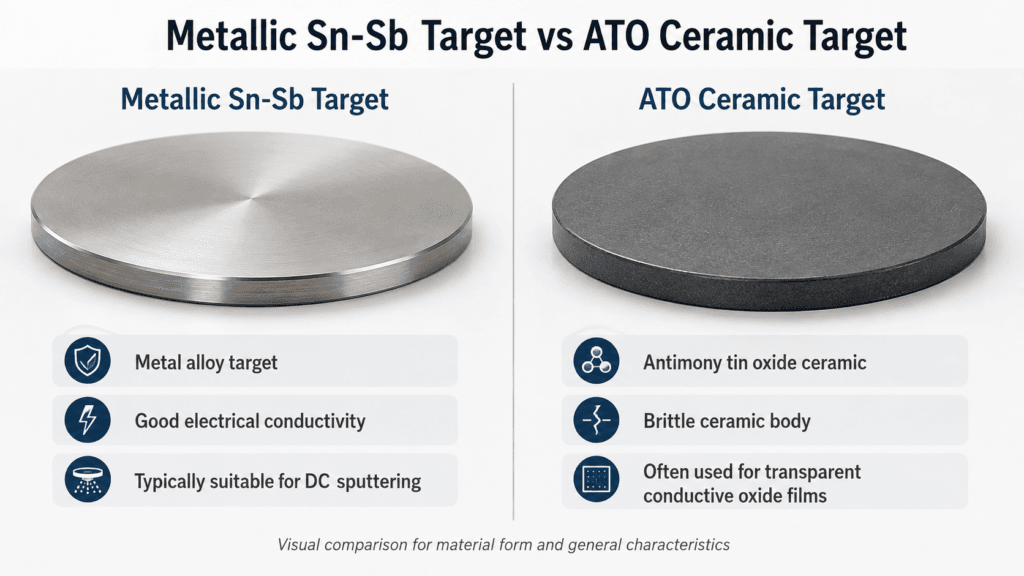
A metallic Sn-Sb sputtering target is an alloy target consisting primarily of tin (Sn) with controlled antimony (Sb) addition.
Typical compositions include:
- Sn-Sb alloy targets
- Tin-rich Sn-Sb materials
- Custom Sb concentration based on application requirements
Unlike oxide targets, metallic Sn-Sb targets contain the elements in their metallic state.
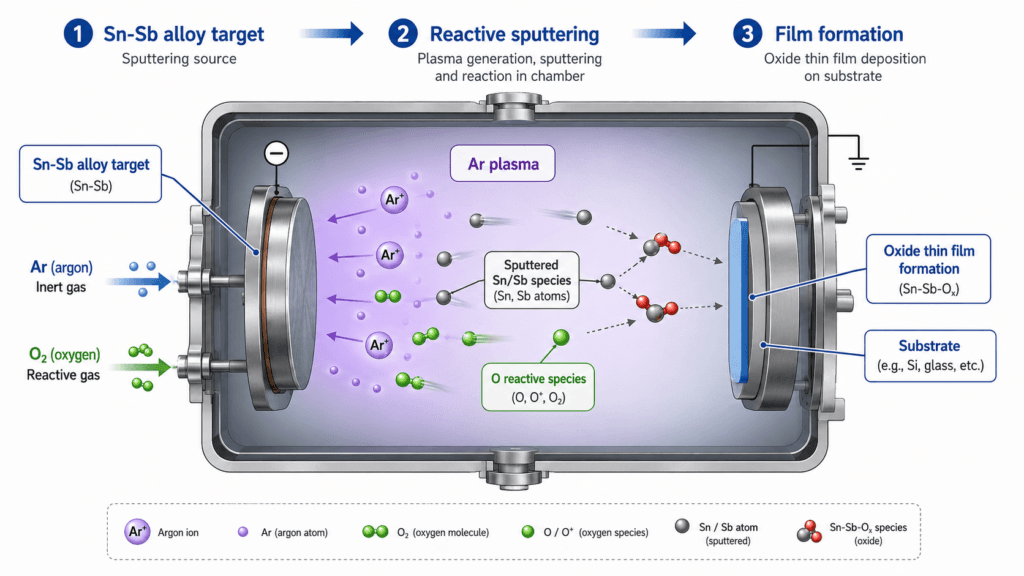
During sputtering, the target atoms are physically removed from the metallic surface and deposited onto a substrate. If oxide films are required, oxygen can be introduced during a reactive sputtering process.
The main advantage of metallic Sn-Sb targets is flexibility:
- The same target can be used for metallic alloy films
- Reactive sputtering allows oxide film formation
- Composition adjustment can be controlled through alloy design and process parameters
2. What Is an ATO Ceramic Sputtering Target?
ATO refers to Antimony Tin Oxide, generally based on tin oxide (SnO₂) doped with antimony.
The material structure is an oxide ceramic system:
SnO₂:Sb
Unlike metallic Sn-Sb alloy targets, ATO targets already contain oxygen in the target material.
During sputtering, oxide species are directly transferred from the ceramic target to the substrate.
ATO ceramic targets are commonly used when depositing:
- Transparent conductive oxide (TCO) films
- Antimony-doped tin oxide coatings
- Conductive oxide layers
- Electrostatic protection coatings
Because oxygen is already incorporated into the target structure, ATO sputtering can provide a more direct route for oxide film deposition.
3. Key Difference Between Metallic Sn-Sb and ATO Ceramic Targets
| Comparison | Metallic Sn-Sb Target | ATO Ceramic Target |
|---|---|---|
| Material Type | Metallic alloy | Oxide ceramic |
| Main Components | Sn + Sb | SnO₂ + Sb₂O₃ |
| Oxygen Content | No oxygen in target | Oxygen incorporated |
| Typical Process | DC sputtering or reactive sputtering | RF/DC reactive-compatible oxide sputtering |
| Film Control | Requires oxygen process control for oxide films | Direct oxide deposition |
| Conductivity of Target | High electrical conductivity | Lower conductivity than metal |
| Manufacturing | Alloy melting/casting/processing | Ceramic powder preparation and sintering |
| Typical Applications | Alloy films, reactive oxide films | Transparent conductive oxide coatings |
4. Why Choose Metallic Sn-Sb Target?
Metallic Sn-Sb targets provide several advantages for researchers who need process flexibility.
4.1 Flexible Film Chemistry Control
With reactive sputtering, oxygen flow can be adjusted during deposition.
This allows engineers to control:
- Oxygen concentration
- Film stoichiometry
- Electrical properties
- Optical transparency
This approach is useful when developing new Sn-Sb oxide thin films.
4.2 Higher Target Conductivity
Metallic targets generally have better electrical conductivity compared with ceramic targets.
This allows compatibility with:
- DC magnetron sputtering systems
- High-rate deposition processes
- Industrial coating equipment
4.3 Easier Integration With Metallic Thin Films
For applications requiring metallic Sn-Sb layers rather than oxide films, a metallic target avoids unnecessary oxygen control.
5. Why Choose ATO Ceramic Target?
ATO ceramic targets are preferred when the final film requirement is already defined as an oxide conductive layer.
Advantages include:
5.1 Direct Oxide Deposition
Since oxygen exists in the target material, the deposition process can focus on maintaining film uniformity rather than forming the oxide phase from metallic atoms.
5.2 Stable Transparent Conductive Films
ATO films are investigated as alternatives to conventional transparent conductive materials because of their:
- Electrical conductivity
- Optical transparency
- Chemical stability
Applications include:
- Transparent electrodes
- Display-related coatings
- Solar energy devices
- Functional glass coatings
6. Deposition Process Considerations
The selection between Sn-Sb alloy and ATO ceramic depends strongly on the sputtering process.
Metallic Sn-Sb Process
Common process route:
Metallic Sn-Sb Target
↓
DC Magnetron Sputtering
↓
(Optional Reactive Oxygen Introduction)
↓
Sn-Sb-O Thin Film
Important parameters:
- Oxygen flow ratio
- Chamber pressure
- Substrate temperature
- Target power
- Deposition rate
ATO Ceramic Process
Common process route:
ATO Ceramic Target
↓
RF/DC Sputtering
↓
ATO Thin Film
Important parameters:
- Target density
- Ceramic microstructure
- Oxygen stoichiometry
- RF power stability
7. How to Select the Right Sn-Sb Target?
Before purchasing, engineers should confirm several key specifications.
| Parameter | Why It Matters |
|---|---|
| Sn/Sb Ratio | Determines film composition and electrical properties |
| Purity Level | Influences contamination and film quality |
| Target Density | Affects sputtering efficiency and stability |
| Target Size | Must match cathode dimensions |
| Bonding Method | Determines thermal management |
| Deposition Method | DC, RF, or reactive sputtering compatibility |
| Film Requirement | Metallic Sn-Sb, Sn-Sb oxide, or ATO coating |
For custom requirements, MetalsTek can review:
- Target composition
- Diameter or rectangular dimensions
- Thickness
- Backing plate requirements
- Cathode compatibility
8. Applications of Sn-Sb-Based Thin Films
Sn-Sb materials are studied across several advanced coating fields.
Transparent Conductive Films
Antimony-doped tin oxide coatings are investigated for conductive transparent layers.
Related research fields include:
- Solar cells
- Displays
- Smart glass
- Optical coatings
External reference:
https://www.sciencedirect.com/topics/engineering/antimony-doped-tin-oxide
Semiconductor and Electronic Devices
Sn-Sb oxide films have been studied for:
- Electrical sensing layers
- Functional oxide devices
- Surface conductive coatings
External reference:
https://www.mdpi.com
Energy-Related Applications
Tin-based oxide materials are widely researched for:
- Battery electrode materials
- Electrochemical devices
- Energy conversion systems
External reference:
https://www.energy.gov
9. Related Products
MetalsTek supplies various metal and alloy sputtering targets for thin-film deposition:
Tin Sputtering Target
High-purity tin targets for:
- Semiconductor processes
- Thin-film research
- Alloy coating development
Product:
https://metalstek.com/base-metals/tin/tin-sputtering-targets/
Antimony Sputtering Target
Used for:
- Alloy development
- Semiconductor research
- Functional thin films
Copper Sputtering Target
Commonly used for:
- Conductive films
- Metallization processes
Indium Tin Oxide (ITO) Target
Alternative transparent conductive oxide material for comparison with ATO-based coatings.
10. FAQ
Is Sn-Sb the same as ATO?
No. Sn-Sb is a metallic alloy containing tin and antimony, while ATO is an oxide ceramic material based on tin oxide doped with antimony.
Can a metallic Sn-Sb target produce oxide films?
Yes. Reactive sputtering with oxygen introduction can produce Sn-Sb oxide films.
Which target is better for transparent conductive films?
ATO ceramic targets are commonly selected for direct oxide deposition, while metallic Sn-Sb targets provide greater process flexibility.
Can Sn-Sb targets be customized?
Yes. Composition, dimensions, thickness, bonding method, and cathode interface can be customized.
What information is needed for quotation?
Typical requirements include target material, composition, purity, dimensions, quantity, bonding requirements, and sputtering system information.
Conclusion
Metallic Sn-Sb sputtering targets and ATO ceramic targets serve related but different roles in thin-film deposition.
Metallic Sn-Sb targets provide flexibility through alloy composition and reactive sputtering control, while ATO ceramic targets offer a direct route for antimony-doped tin oxide film deposition.
Selecting the correct target depends on the required film properties, deposition system, and process objectives.
MetalsTek supports customized sputtering target solutions, including tin-based alloy targets, oxide targets, and application-specific configurations.
For detailed specifications and quotation, please contact us at: