In the highly specialized field of advanced materials manufacturing, synthesizing single crystals—such as Sapphire (Al₂O₃), Lithium Tantalate (LiTaO₃), Lithium Niobate (LiNbO₃), and Yttrium Aluminum Garnet (YAG)—requires pushing thermodynamics to its absolute limits. Operating at temperatures that routinely exceed 2000°C, crystal growth furnaces are unforgiving environments. A single material failure, whether through high-temperature oxidation, structural creep, or chemical contamination, can lead to the catastrophic loss of an entire crystal boule, costing tens of thousands of dollars in wasted energy, raw materials, and time.
For equipment engineers and procurement managers, selecting the correct crucible and shielding material is the most critical decision in furnace design. While refractory metals and platinum group metals (PGMs) are the default choices, not all perform equally under extreme thermal stress and oxidizing atmospheres.
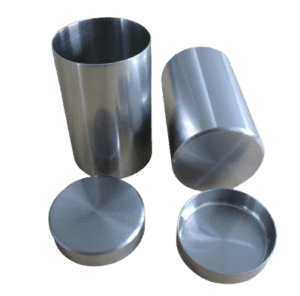
This comprehensive guide provides an in-depth comparative analysis of Iridium, Platinum, and Tungsten, detailing why Iridium Plate and manufactured Iridium crucibles remain the undisputed champions for the most demanding high-temperature crystal growth applications.
1. The Thermodynamic Demands of High-Temperature Crystal Growth
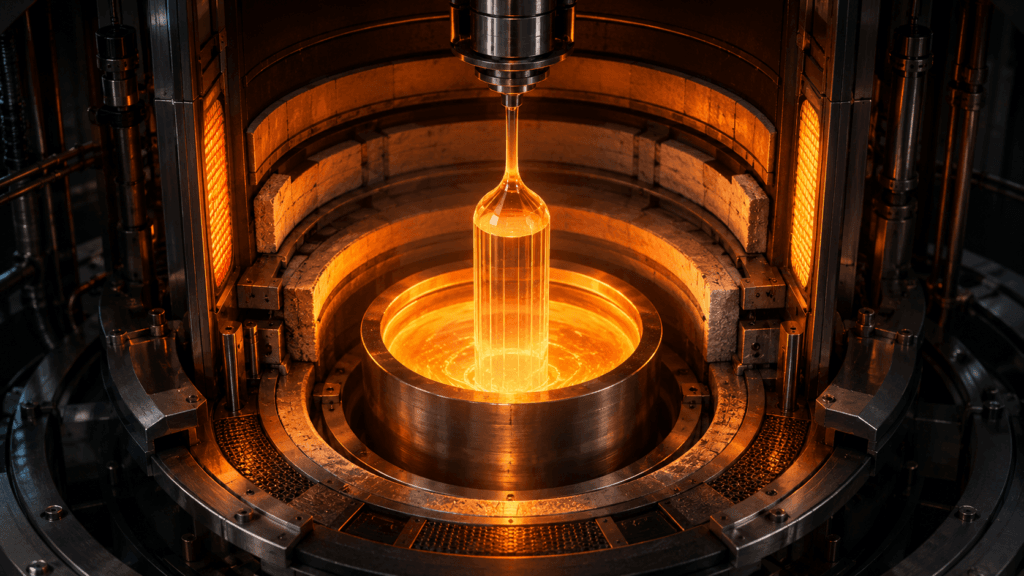
The synthesis of synthetic optical and acoustic crystals primarily utilizes the Czochralski (Cz) method, the Kyropoulos method, or the Heat Exchanger Method (HEM). In these processes, raw oxide powders are melted inside a crucible, and a seed crystal is slowly extracted or cooled to form a massive, defect-free single crystal boule.
The chosen crucible and surrounding thermal shielding materials must possess:
- An Ultra-High Melting Point: The material must withstand temperatures hundreds of degrees above the melting point of the crystal being grown.
- Exceptional Oxidation Resistance: Many oxide crystals release oxygen as they melt, creating an aggressive oxidizing atmosphere.
- Chemical Inertness: The crucible must not react with the molten oxide bath; otherwise, the crystal will suffer from elemental contamination (doping), ruining its optical or piezoelectric properties.
- High-Temperature Creep Resistance: The material must maintain strict dimensional tolerances without warping or buckling under its own weight and the weight of the molten bath over multi-week growth cycles.
2. Iridium: The Undisputed King of Oxidizing Environments
When dealing with ultra-high temperatures in the presence of oxygen, Iridium is fundamentally peerless. As the most corrosion-resistant element on the periodic table, Iridium boasts a melting point of 2446°C (4435°F).
Crucially, unlike other refractory metals, Iridium does not suffer from catastrophic oxidation at these extremes. It can safely operate in weakly oxidizing atmospheres at temperatures up to 2200°C without significant volatilization or structural degradation. This makes formed Iridium Sheet the global standard for manufacturing crucibles used in the Czochralski growth of massive sapphire boules (which require melt temperatures around 2050°C).
Furthermore, Iridium possesses an extraordinarily high modulus of elasticity (528 GPa) and excellent High-Temperature Creep Resistance. This ensures that large crucibles do not bulge, sag, or fail during the month-long thermal cycles required to grow large-diameter crystals.
Table 1: Thermophysical Properties of Iridium vs. Crystal Growth Demands
| Property | Iridium Value | Relevance to Crystal Growth |
| Melting Point | 2446°C | Provides a safe thermal buffer above the 2050°C melting point of sapphire. |
| Oxidation Resistance | Superior up to 2200°C | Resists the aggressive oxygen outgassing from molten oxide baths. |
| Chemical Inertness | Unreactive with most oxides | Prevents transition-metal contamination, ensuring pure, colorless crystals. |
| Modulus of Elasticity | 528 GPa | Prevents high-temperature creep and crucible wall buckling under load. |
| Density | 22.56 g/cm³ | High density allows for uniform, stable induction heating of the crucible. |
3. Platinum: Excellent Ductility but Temperature Limited
Platinum is another noble metal widely used in crystal growth, particularly for lower-temperature oxides and specialized glass melting. Its primary advantage lies in its supreme workability and oxidation resistance. Unlike Iridium, which undergoes a ductile-to-brittle transition and is notoriously difficult to machine, Platinum is highly ductile. It can be easily deep-drawn, spun, and welded into complex crucible geometries without the risk of micro-fracturing.
Additionally, Platinum is completely inert in air and oxygen at all temperatures up to its melting point. It does not form a volatile oxide layer, making it the perfect choice for high-purity medical-grade optics and specific scintillator crystals.
The Fatal Flaw for Extreme Crystal Growth:
Platinum’s limitation is strictly thermal. With a melting point of 1768°C (3214°F), it is entirely useless for growing high-temperature oxides like Sapphire (2050°C) or YAG (1950°C). It is generally restricted to applications where the melt temperature does not exceed 1500°C to 1600°C, such as the growth of certain Bismuth or Tellurium-based compounds.
4. Tungsten: The Ultra-High Temperature Champion with a Fatal Flaw
If evaluated purely on raw thermal capacity, Tungsten is the undisputed heavyweight. With a staggering melting point of 3422°C (6192°F)—the highest of all metals in pure form—Tungsten is a staple in extreme engineering. It possesses phenomenal High-Temperature Creep Resistance and a very low Coefficient of Thermal Expansion (CTE), making it an excellent structural material for furnace heating elements and thermal shielding.
The Fatal Flaw for Extreme Crystal Growth:
Tungsten’s Achilles’ heel is oxygen. While it performs flawlessly in High Vacuum Environments or pure inert gas (Argon/Helium) atmospheres, Tungsten suffers from catastrophic, rapid oxidation when exposed to even trace amounts of oxygen at elevated temperatures. Above 600°C, Tungsten begins to form volatile oxides ($WO_3$) that sublimate, literally evaporating the metal.
Because the growth of oxide single crystals (like sapphire) naturally releases oxygen into the furnace atmosphere, a Tungsten crucible would rapidly oxidize, contaminate the crystal melt with Tungsten particles, and ultimately undergo structural failure. Therefore, Tungsten is restricted to the growth of non-oxide crystals (like Silicon or Gallium Arsenide) or used as external shielding in vacuum-sealed zones safely away from the oxidizing melt.
5. Horizontal Material Selection Matrix
To simplify the procurement and engineering decision-making process, below is a transverse comparison of these three critical metals.
Table 2: Horizontal Material Comparison for Crystal Growth
| Feature | Iridium (Ir) | Platinum (Pt) | Tungsten (W) |
| Melting Point | 2446°C | 1768°C | 3422°C |
| Max Operating Temp (Oxidizing) | ~2200°C | ~1600°C | < 500°C (Fails rapidly) |
| Max Operating Temp (Vacuum/Inert) | ~2200°C | ~1600°C | ~2800°C |
| Machinability / Ductility | Very Difficult (Brittle) | Excellent (Highly Ductile) | Difficult (Brittle at room temp) |
| Cost Profile | Very High | High | Moderate |
| Primary Crystal Applications | Sapphire, YAG, LSO, GGG | Glass, Bismuth/Tellurium oxides | Silicon, SiC, GaAs, Furnace Shielding |
| Failure Mode in Oxide Growth | Gradual wall thinning (IrO₂ loss) | Melting/Creep if > 1600°C | Catastrophic oxidation ($WO_3$ evaporation) |
6. Overcoming Iridium Manufacturing Challenges: The Metalstek Advantage
Knowing that Iridium is the only viable choice for high-temperature oxide crystal growth is only half the battle. Procuring high-quality Iridium components is a significant engineering challenge. Due to its face-centered cubic (FCC) crystal structure, Iridium is exceptionally prone to intergranular fracture. Standard casting methods often result in severe porosity, grain boundary weakness, and internal voids—defects that will cause a crucible to leak molten sapphire during a growth cycle.
How Metalstek Solves the Iridium Problem:
At Metalstek, we leverage advanced metallurgical techniques to produce Iridium components that guarantee structural integrity under extreme conditions.
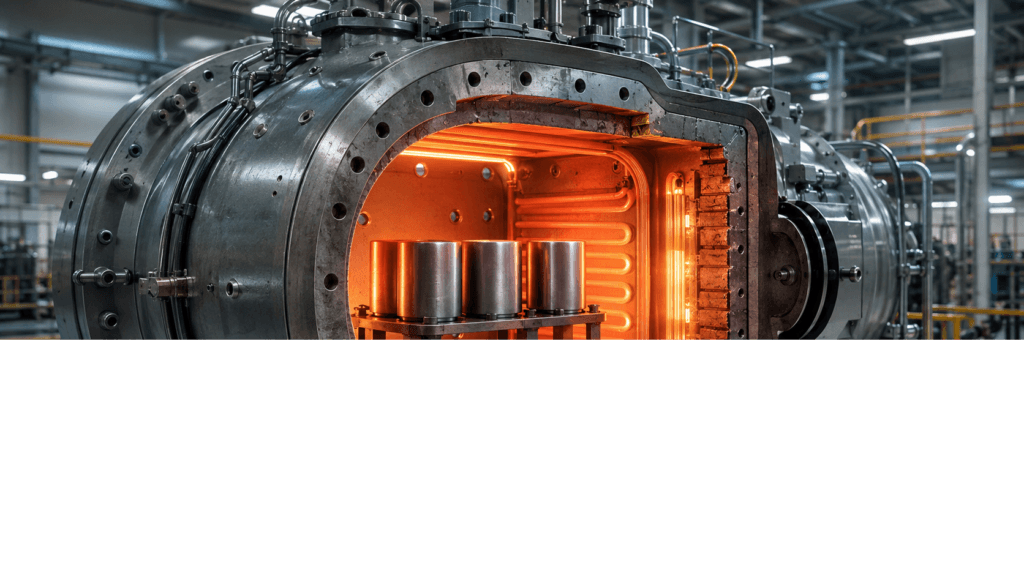
- Ultra-High Purity (4N/5N): Even trace impurities (like Iron, Silicon, or Carbon) migrate to grain boundaries at high temperatures, drastically reducing Iridium’s ductility and causing premature rupture. Metalstek ensures material purity up to 99.99% (4N) and 99.999% (5N), eliminating these failure points and ensuring zero contamination of your crystal boule.
- Powder Metallurgy & HIP: Instead of traditional casting, we utilize state-of-the-art near-net-shape powder metallurgy followed by Hot Isostatic Pressing (HIP). This combination subjects the sintered Iridium to massive isotropic pressure at high temperatures, effectively closing all internal microporosity and yielding a crucible wall with 100% theoretical density.
- Advanced Precision Machining: To achieve tight dimensional tolerances without inducing micro-cracks, Metalstek utilizes non-conventional machining techniques, including Wire Electrical Discharge Machining (EDM) and high-temperature laser cutting.
- Specialized Forming: From thick Iridium Plate for structural furnace bases to ultra-thin Iridium Foil for specialized shielding, we have the thermo-mechanical processing schedules perfected to deliver flawless planar products.
Table 3: Metalstek Iridium Dimensional Capabilities
| Product Form | Manufacturing Method | Dimensional Range | Typical Application |
| Iridium Crucibles | Powder Metallurgy + Deep Drawing | Up to 400mm Diameter | Sapphire & YAG Czochralski growth. |
| Iridium Sheet & Plate | Isostatic Pressing + Hot Rolling | Thickness: 0.1mm – 20.0mm | Furnace floor plates, structural supports. |
| Iridium Foil | Precision Cold Rolling + Annealing | Thickness: 0.01mm – 0.09mm | High-temperature sensors, protective shielding. |
| Custom Iridium Parts | Wire EDM & 5-Axis CNC | Per CAD Specifications | Afterburners, spark plug electrodes, seed holders. |
7. Real-World Applications: Where Iridium Outperforms
Sapphire (Al₂O₃) for LED and Optics:
The global demand for LED substrates and scratch-resistant smart device optics relies entirely on synthetic sapphire. With a melting point of 2050°C, the Kyropoulos method demands a crucible that can hold a massive pool of molten alumina for weeks. Tungsten would burn up; Platinum would melt. Metalstek’s high-density Iridium crucibles are the industry standard for yielding 100kg+ sapphire boules.
Lithium Tantalate (LiTaO₃) & Lithium Niobate (LiNbO₃):
These crystals are the backbone of the 5G telecommunications industry, used in Surface Acoustic Wave (SAW) filters. Growing them requires highly controlled atmospheres to maintain stoichiometry. Iridium’s chemical inertness ensures the precise doping levels required for perfect acoustic wave propagation are not disrupted by crucible degradation.
Yttrium Aluminum Garnet (YAG):
Used in industrial and medical solid-state lasers (Nd:YAG), these crystals demand extreme optical clarity. Any metallic inclusions from a degrading crucible will cause the laser to fracture the crystal from the inside out. Metalstek’s 5N purity Iridium prevents trace element contamination, guaranteeing high laser-damage thresholds.
8. Conclusion: Securing Your Supply Chain for Extreme Environments
Selecting the right material for high-temperature crystal growth is a high-stakes engineering decision. While Tungsten offers raw thermal resistance in vacuums, and Platinum offers unmatched ductility at lower temperatures, Iridium stands alone as the only metal capable of surviving the brutal, oxidizing, 2000°C+ environments required for advanced oxide crystal synthesis.
Partnering with an experienced metallurgical manufacturer is just as important as the material selection itself. Metalstek’s stringent quality control, verifiable traceability, and mastery over powder metallurgy ensure that your Iridium components perform flawlessly, maximizing your furnace yield and minimizing downtime.
Ready to upgrade your extreme environment capabilities?
Don’t let material limitations dictate your crystal yield. Metalstek provides end-to-end solutions, from raw Iridium Sheet to fully finished, precision-machined crucibles.
[Submit your CAD Drawing for a Technical Evaluation] | [Request a 5N Iridium Material Specification Sheet] | [Contact Our Engineering Sales Team for a Custom Quote]
Frequently Asked Questions (FAQs)
1. Why can’t I use a Tungsten crucible for Sapphire growth?
Sapphire ($Al_2O_3$) growth involves melting aluminum oxide. At high temperatures, this melt releases oxygen into the furnace atmosphere. Tungsten has practically zero oxidation resistance above 600°C and will rapidly oxidize into volatile $WO_3$ gas. This will destroy the crucible and severely contaminate the sapphire boule.
2. At what temperature does Iridium begin to lose mass due to oxidation?
While Iridium is highly resistant, it is not completely immune. Above 1600°C in air, it slowly forms $IrO_2$ and $IrO_3$, which are volatile. However, the rate of loss is incredibly slow compared to other refractory metals, allowing Iridium crucibles to operate for hundreds of hours at 2100°C before significant wall thinning occurs.
3. How does Metalstek achieve 5N (99.999%) purity in its Iridium products?
We utilize advanced chemical refining processes, including solvent extraction and high-temperature vacuum outgassing, to remove trace transition metals (like Fe, Ni, Cu) and non-metals (C, O, N) before the Powder Metallurgy consolidation phase.
4. Can a damaged Iridium crucible be repaired or recycled?
Yes. Because Iridium is a highly valuable precious metal, end-of-life or deformed crucibles retain significant value. Metalstek offers refining and recycling services, allowing customers to melt down old crucibles and re-fabricate them into new ones, drastically reducing long-term OPEX.
5. What is the difference between casting and Powder Metallurgy for Iridium?
Casting liquid Iridium often results in large, coarse grain structures and internal shrinkage cavities (porosity), making the metal weak and prone to leaking. Powder metallurgy involves pressing fine Iridium powder into a shape and sintering it below its melting point, resulting in a fine, uniform grain structure with superior mechanical strength.
6. Is Platinum ever used in combination with Iridium?
Yes. For applications operating between 1600°C and 1900°C, Platinum-Iridium alloys (e.g., Pt-20Ir or Pt-30Ir) are sometimes used. These alloys offer a compromise, combining the superior ductility and fabrication ease of Platinum with the enhanced high-temperature strength and melting point of Iridium.
7. How thick should an Iridium crucible wall be for large crystal growth?
Wall thickness depends on the melt volume and the specific thermal gradients of the furnace. For large Sapphire boules (85kg+), wall thicknesses typically range from 2.0mm to 4.0mm to provide adequate high-temperature creep resistance and to withstand the hydrostatic pressure of the dense oxide melt.
8. Why is precision machining Iridium so challenging?
Iridium has an extremely high rate of work hardening and tends to fracture along grain boundaries rather than shear smoothly under a cutting tool. Standard CNC milling often destroys the tool and the part. Metalstek overcomes this by using Wire EDM (Precision Machining), which cuts the metal using electrical sparks, exerting zero physical force on the brittle material.
9. Can Iridium Foil be used as a heat shield in a Tungsten furnace?
Absolutely. In ultra-high vacuum or inert environments, Iridium Foil can be used alongside Tungsten shielding. Iridium’s high density and high melting point make it an excellent reflective heat shield, and its low vapor pressure ensures it will not outgas and contaminate a high-vacuum chamber.
10. What is the standard lead time for a custom Iridium crucible from Metalstek?
Due to the rarity of the raw material, the extensive refining required for 4N/5N purity, and the rigorous HIP and machining schedules, custom Iridium crucibles generally have a lead time of 6 to 10 weeks. We recommend proactive supply chain planning and working closely with our sales team to forecast your needs.