Choose Nickel 200 or Nickel 201 for a crucible by reviewing the operating temperature, exposure time, atmosphere and contents before settling the drawing. Nickel 201 is the low-carbon grade and is generally preferred when extended service above about 315°C (600°F) makes graphitization of Nickel 200 a concern. That threshold is a grade-selection guide, not a guaranteed maximum temperature for every finished crucible. The vessel geometry, lid, process chemistry and acceptance requirements still need separate review.
This guide supports the MetalsTek nickel crucible product page. It explains how to choose a grade and prepare a drawing-based inquiry; current product forms and quotation details remain on the product page.
Nickel 200 vs. Nickel 201: the decision in one table
| Selection point | Nickel 200 (UNS N02200) | Nickel 201 (UNS N02201) | What to specify for a crucible |
|---|---|---|---|
| Carbon limit | 0.15% maximum | 0.02% maximum | State the grade or carbon requirement and request the required material documentation. |
| Prolonged elevated-temperature exposure | Graphitization and embrittlement require particular attention. | Low-carbon grade is generally preferred above about 315°C (600°F). | Provide operating temperature, peak temperature, hold time and cycling profile. |
| Corrosive or reactive contents | Neither grade is universally compatible with all acids, salts, melts or furnace atmospheres. | Identify the contents, atmosphere and possible contaminants before selecting either grade. | |
| Finished part | Grade selection alone does not define vessel or lid performance. | Provide a drawing, lid fit, wall and bottom geometry, quantity and inspection criteria. | |
The carbon limits and elevated-temperature distinction are documented by the Nickel Institute’s fabrication guidance. They describe material behavior; they do not certify a particular MetalsTek part for a particular process.
Why does the carbon difference matter?
Nickel 201 limits carbon more tightly than Nickel 200. With prolonged exposure in the relevant temperature range, carbon in Nickel 200 can precipitate as graphite and reduce ductility. This is why Nickel 201 is commonly preferred for service above roughly 315°C. The risk depends on time and temperature; a brief heating cycle and a long hold should not be treated as identical service conditions.
Do not interpret 315°C as the maximum permissible temperature of a Nickel 201 crucible, or assume that changing from 200 to 201 resolves every high-temperature issue. The acceptable operating window for a finished crucible depends on its construction, load, atmosphere, contact material and required life. A material data sheet or code limit for another component is not a blanket rating for an open laboratory vessel.
Check the process before choosing either grade
Temperature and exposure. Record normal and peak temperatures, hold duration and thermal cycling. If elevated-temperature exposure is central to the process, ask for a grade review rather than relying on a single published number.
Atmosphere and contents. Identify air, vacuum or controlled gas; the sample or melt; and possible sulfur-bearing or oxidizing contaminants. Nickel’s resistance to some caustic environments does not make either grade suitable for every chemical or molten charge. The user’s process owner must confirm material compatibility for the actual conditions.
Crucible construction. A deep vessel, shallow cup, thin wall, reinforced bottom or close-fitting lid may create different fabrication and inspection questions. Specify the lid as part of the assembly when its seating, clearance or handling features matter. Do not assume that a lid makes the vessel gas-tight.
What does a custom nickel crucible RFQ need?
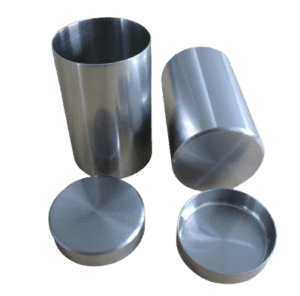
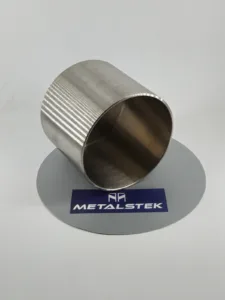
MetalsTek has delivered a custom Ni 201 crucible with a lid to a customer drawing. That completed order supports the stated product combination, but its customer identity, order details and full dimensions are not public. It does not establish a standard size range for all Ni 201 crucibles.
For a useful quotation, send the information that controls grade choice and part acceptance:
- Material request: Nickel 200, Nickel 201, another nickel grade, or an open grade-selection question.
- Drawing and revision, or required capacity, inner and outer dimensions, wall and bottom geometry, rim details and tolerances.
- Lid drawing or required fit, including whether the lid is loose, recessed or otherwise located.
- Operating and peak temperature, hold time, atmosphere, contents and known contaminants.
- Quantity, required material documentation, dimensional inspection points, surface/cleanliness requirements and delivery destination.
If the application needs a numerical purity such as Ni 99.99%, state that separately. Nickel 201 is a low-carbon grade designation, not a synonym for 99.99% nickel. The requested grade and purity must both be checked against the available material and certificate.
Review nickel crucible options and request a drawing-based quote →
Frequently asked questions
Is Nickel 201 always better than Nickel 200 for a crucible?
No. Nickel 201 is the lower-carbon choice when the service profile makes graphitization of Nickel 200 a concern. For other conditions, the grade should be selected against the actual temperature, contents, atmosphere, geometry and documentation requirements.
Does 315°C mean a nickel crucible cannot be used above that temperature?
No. About 315°C is a commonly cited point for preferring low-carbon Nickel 201 over Nickel 200 in prolonged elevated-temperature service. It is not a universal maximum operating temperature for every crucible; the complete application must be reviewed.
Can a custom Nickel 201 crucible be supplied with a lid?
Yes. MetalsTek has delivered a drawing-based Ni 201 crucible with a lid. Send the vessel and lid requirements together so fit and inspection points can be quoted for the specific design.
Is Nickel 201 the same as 99.99% pure nickel?
No. Nickel 201 identifies a low-carbon material grade; 99.99% describes a separate purity requirement. If both matter, specify both and request the applicable material documentation.
For the available product forms and quotation route, visit the nickel crucible product page. The broader nickel product family covers other nickel forms when a finished crucible is not the required purchase.