Introduction
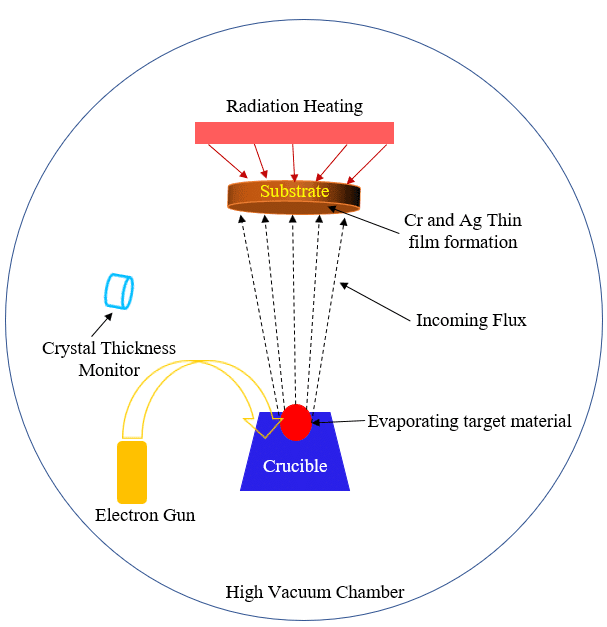
In electron beam (E-beam) evaporation, the crucible is far more than a simple container—it directly influences thermal stability, evaporation efficiency, and thin film purity. Selecting the right crucible material is critical, especially in high-vacuum and high-temperature environments used in semiconductor fabrication, optical coatings, and advanced research.
Among refractory metals, molybdenum (Mo) and tungsten (W) are the two most widely used materials for E-beam crucibles. While they share similarities such as high melting points and excellent vacuum compatibility, their differences can significantly impact deposition performance and cost efficiency.
This guide provides a detailed comparison of molybdenum and tungsten E-beam crucibles, helping engineers and buyers choose the most suitable option for their applications.
Overview of Molybdenum and Tungsten
Molybdenum (Mo)
Molybdenum is a refractory metal known for its excellent balance of high-temperature strength, thermal conductivity, and machinability. It is widely used in vacuum environments due to its low vapor pressure and good resistance to thermal shock.
Key characteristics:
- Melting point: ~2623°C
- Density: 10.2 g/cm³
- High thermal conductivity
- Good machinability and cost efficiency
Tungsten (W)
Tungsten has the highest melting point of all metals, making it ideal for extreme-temperature applications. It also offers superior resistance to deformation at elevated temperatures.
Key characteristics:
- Melting point: ~3422°C
- Density: 19.3 g/cm³
- Exceptional high-temperature strength
- Lower thermal expansion
Key Differences Between Molybdenum and Tungsten Crucibles
1. Temperature Resistance
| Property | Molybdenum | Tungsten |
|---|---|---|
| Maximum Operating Temperature | ~1800–2000°C (vacuum) | >2200°C (vacuum) |
| Melting Point | 2623°C | 3422°C |
Tungsten clearly outperforms molybdenum in extreme temperature environments. For materials requiring very high evaporation temperatures (e.g., refractory oxides or metals), tungsten is often the only viable choice.
However, molybdenum is sufficient—and often preferable—for most standard deposition processes due to lower cost and better thermal response.
2. Thermal Conductivity and Heat Distribution
Molybdenum has higher thermal conductivity than tungsten, which allows:
- More uniform heat distribution
- Stable evaporation rates
- Reduced localized overheating
This makes molybdenum particularly suitable for:
- Organic materials
- Low-to-medium melting point metals
- Precision thin film applications
Tungsten, while strong at high temperatures, may exhibit more localized heating due to lower thermal conductivity.
3. Mechanical Properties and Machinability
| Aspect | Molybdenum | Tungsten |
|---|---|---|
| Machinability | Good | Difficult |
| Brittleness | Moderate | High |
| Fabrication Cost | Lower | Higher |
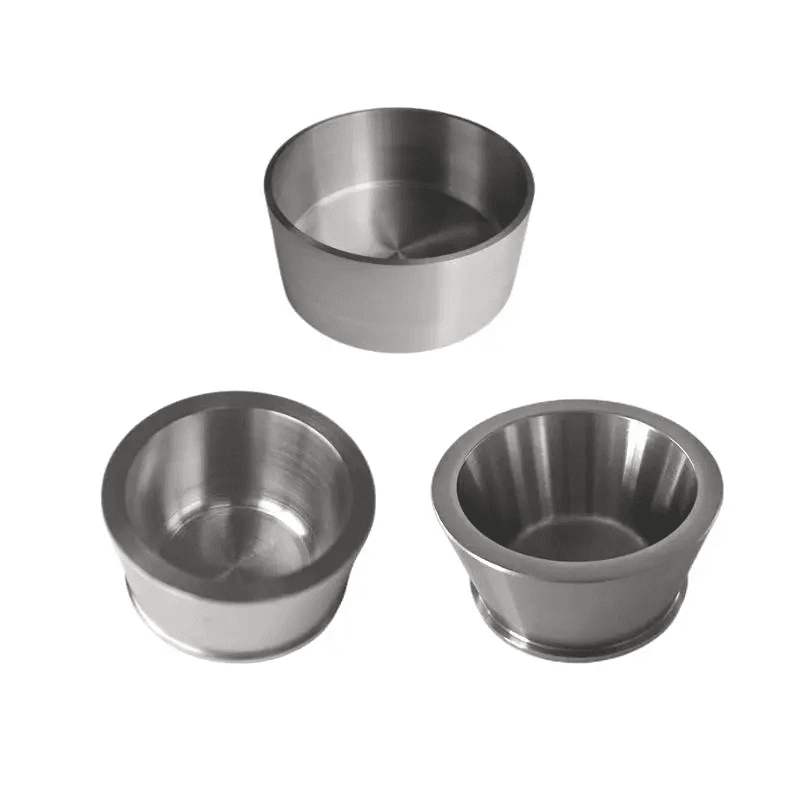
Molybdenum is significantly easier to machine into complex shapes such as:
- Multi-pocket crucibles
- Custom geometries
- Thin-wall designs
Tungsten, due to its brittleness and hardness, is more challenging and expensive to process.
4. Density and Weight
Tungsten is nearly twice as dense as molybdenum. This affects:
- Handling and installation
- Thermal inertia
- Mechanical stress on fixtures
For systems requiring lighter components or frequent replacement, molybdenum is often more practical.
5. Cost Considerations
Molybdenum crucibles are generally more cost-effective due to:
- Lower raw material cost
- Easier machining
- Shorter production cycles
Tungsten crucibles, while more expensive, offer longer service life in extreme conditions, which may offset initial cost in certain applications.
6. Contamination and Purity Control
Both materials exhibit:
- Low vapor pressure
- Good compatibility with high vacuum
However:
- Molybdenum may oxidize more easily if exposed to residual oxygen
- Tungsten provides slightly better chemical stability at ultra-high temperatures
For ultra-high purity deposition, both materials must be processed with high density and refined grain structure.
Applications Comparison
| Application | Preferred Material | Reason |
|---|---|---|
| Organic evaporation (OLED) | Molybdenum | Better thermal control |
| Metal evaporation (Al, Ag, Au) | Molybdenum | Cost-effective and stable |
| High-melting-point materials | Tungsten | Superior temperature resistance |
| Oxide evaporation | Tungsten | Chemical stability |
| Research & lab-scale deposition | Molybdenum | Flexibility and lower cost |
How to Choose the Right Crucible
Choose Molybdenum if:
- Your process temperature is below ~1800–2000°C
- You need uniform heating and stable evaporation
- Cost efficiency is important
- Custom shapes or rapid prototyping are required
Choose Tungsten if:
- Your process involves extremely high temperatures (>2000°C)
- You are evaporating refractory materials
- Maximum durability is required
- Budget allows for higher upfront investment
Design Considerations for E-Beam Crucibles
Regardless of material, performance also depends on design:
- Wall thickness: Influences heat transfer and lifetime
- Pocket geometry: Affects evaporation uniformity
- Surface finish: Impacts contamination and nucleation
- Density (>95%): Critical for avoiding outgassing
Advanced designs may include:
- Multi-pocket crucibles for co-evaporation
- Lined crucibles for sensitive materials
- Custom geometries for specific E-beam guns
Common Issues and Solutions
Cracking or Warping
- Caused by thermal stress or rapid heating
- Solution: Gradual ramp-up and high-density material
Contamination
- From impurities or oxidation
- Solution: Use high-purity material and proper storage
Uneven Evaporation
- Due to poor thermal distribution
- Solution: Optimize crucible geometry and material choice
Future Trends
As deposition technologies evolve, demand is increasing for:
- Ultra-high purity crucibles
- Precision-machined geometries
- Longer lifetime materials
- Hybrid or coated crucibles
Molybdenum continues to dominate general applications, while tungsten remains essential for extreme environments.
Conclusion
Both molybdenum and tungsten E-beam crucibles play critical roles in modern thin film deposition. The right choice depends on balancing temperature requirements, cost, machinability, and process stability.
Molybdenum offers versatility, cost efficiency, and excellent thermal behavior for most applications.
Tungsten provides unmatched performance in extreme high-temperature conditions.
Understanding these differences allows engineers and buyers to optimize both performance and total cost of ownership.