
Introduction
Tantalum (Ta) is widely recognized as one of the most chemically stable and thermally resilient refractory metals. When processed into Tantalum Strip Ribbon, this material becomes particularly valuable in advanced industries where high temperature stability, corrosion resistance, and vacuum compatibility are essential.
Tantalum strip ribbons are thin, flat metallic forms typically produced through precision rolling processes. Their geometry provides a large surface area, excellent mechanical flexibility, and efficient heat distribution, making them suitable for applications such as vacuum furnace heating elements, semiconductor manufacturing equipment, capacitor production, and scientific research instrumentation.
As the semiconductor and vacuum technology industries continue to demand materials with high purity, low vapor pressure, and exceptional reliability, tantalum ribbon has become an important component in many high-performance systems.
Detailed Description
Material Characteristics
Tantalum is a refractory metal with a melting point of approximately 3017 °C, placing it among the most heat-resistant metallic elements available for engineering applications. Its crystal structure and atomic stability allow tantalum to maintain mechanical strength even at elevated temperatures.
Tantalum strip ribbon typically exhibits the following characteristics:
- Outstanding corrosion resistance, even in highly aggressive chemical environments
- Excellent ductility and formability, enabling complex shaping and forming processes
- Low vapor pressure, making it ideal for high-vacuum systems
- Superior thermal stability, allowing reliable operation in high-temperature equipment
These properties make tantalum ribbon especially suitable for environments where traditional metals would oxidize, deform, or contaminate sensitive processes.
Manufacturing Process of Tantalum Strip Ribbon
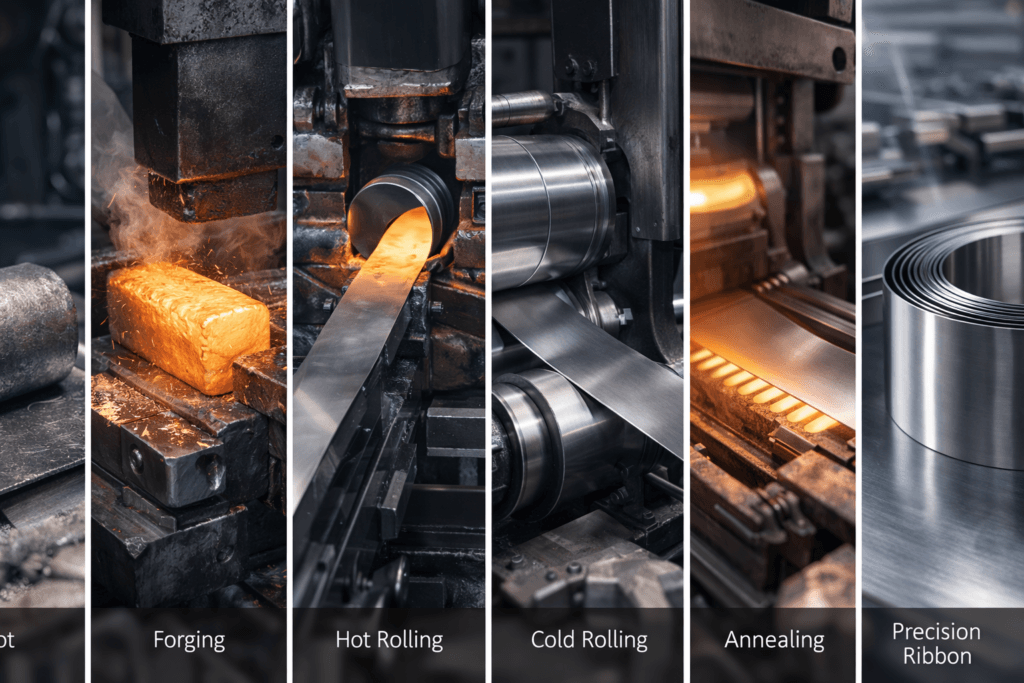
The production of tantalum strip ribbon involves multiple metallurgical processes designed to ensure high purity, uniform microstructure, and precise dimensional control.
Typical manufacturing steps include:
Raw Material Preparation
High-purity tantalum powder is processed through powder metallurgy or melting processes to produce tantalum ingots or billets.
Forging and Hot Working
The ingots are forged to break down the internal structure and improve grain uniformity.
Rolling Process
Through a series of hot and cold rolling operations, the metal is gradually reduced into thin strips or ribbons.
Annealing Treatment
Intermediate annealing is performed to restore ductility and relieve internal stresses generated during rolling.
Precision Slitting and Cutting
Final ribbons are slit into precise widths and thicknesses according to application requirements.
This controlled process ensures the material exhibits uniform thickness, smooth surfaces, and consistent mechanical properties.
Surface Quality and Purity Considerations
For applications in vacuum and semiconductor environments, the surface condition of tantalum ribbon is critical. Surface contaminants, oxide layers, or mechanical defects may introduce unwanted impurities during high-temperature operation.
High-quality tantalum ribbon typically undergoes:
- Surface polishing or chemical cleaning
- Degreasing and vacuum packaging
- Strict contamination control
High purity grades such as 99.9% (3N) or 99.99% (4N) are often required to ensure minimal contamination during thin film deposition or semiconductor processing.
Applications
Tantalum strip ribbon plays an important role across several high-technology industries due to its unique combination of thermal stability, mechanical flexibility, and chemical inertness.
1. Vacuum Furnace Heating Elements
One of the most common uses of tantalum ribbon is in vacuum furnace heating systems. The ribbon geometry allows efficient heat distribution and stable electrical resistance.
Typical uses include:
- Heating elements in high-temperature vacuum furnaces
- Thermal shields and radiant heaters
- Heat distribution components in material processing equipment
2. Semiconductor Manufacturing Equipment
In semiconductor fabrication, materials must maintain purity and stability in ultra-high vacuum (UHV) environments. Tantalum ribbon is frequently used in:
- wafer processing systems
- deposition equipment
- thermal evaporation assemblies
- vacuum-compatible heating structures
Its low outgassing rate and high melting point make it suitable for sensitive semiconductor processes.
3. Capacitor Manufacturing
Tantalum is widely used in the electronics industry for tantalum capacitors, where it serves as a high-reliability electrode material.
Tantalum ribbon may be used in:
- capacitor lead frames
- electrical interconnections
- high-reliability electronic components
The material’s excellent electrical conductivity and chemical stability help ensure long-term reliability in electronic devices.
4. Scientific Research and Laboratory Equipment
Many advanced research systems require materials capable of operating under extreme temperature and vacuum conditions. Tantalum strip ribbon is frequently used in:
- laboratory heating elements
- vacuum experiment setups
- materials testing equipment
- high-temperature sample holders
Because tantalum exhibits low contamination behavior, it is often selected for research environments where purity is critical.
5. Medical and Chemical Industries
Tantalum is known for its biocompatibility and corrosion resistance, making it suitable for specialized medical and chemical applications.
Possible uses include:
- surgical instruments
- implantable medical devices
- corrosion-resistant chemical processing components
Although ribbons are less common than wires or sheets in these sectors, they can still be used in custom fabrication or specialized equipment.
Technical Parameters
| Parameter | Typical Value / Range | Importance |
|---|---|---|
| Purity | 99.9% – 99.99% | Ensures minimal contamination in vacuum environments |
| Width | 1 – 50 mm (custom available) | Determines heating area and electrical characteristics |
| Thickness | 0.02 – 0.5 mm | Influences flexibility and electrical resistance |
| Density | 16.6 g/cm³ | Indicates high structural stability |
| Melting Point | 3017 °C | Enables high-temperature applications |
| Surface Condition | Rolled / polished | Improves vacuum compatibility |
Comparison with Related Materials
In high-temperature and vacuum environments, tantalum ribbon is often compared with other refractory metal materials such as tungsten or molybdenum.
| Material | Key Advantage | Typical Application |
|---|---|---|
| Tantalum Strip Ribbon | Excellent corrosion resistance and ductility | Vacuum furnaces, semiconductor equipment |
| Tungsten Ribbon | Extremely high melting point | High-temperature heating elements |
| Molybdenum Ribbon | Good strength and lower cost | Furnace components and electronics |
Tantalum stands out because it offers a balanced combination of ductility, corrosion resistance, and vacuum compatibility.
FAQ
| Question | Answer |
|---|---|
| Can tantalum strip ribbon be customized? | Yes. Width, thickness, purity, and length can all be customized to meet specific application requirements. |
| Is tantalum ribbon suitable for vacuum environments? | Yes. Its low vapor pressure and low outgassing characteristics make it highly suitable for vacuum and ultra-high vacuum systems. |
| What industries use tantalum ribbon the most? | Semiconductor manufacturing, vacuum furnace systems, electronics, and advanced research laboratories. |
| How is tantalum ribbon typically packaged? | It is usually vacuum sealed or packaged in protective materials to prevent oxidation and contamination during storage and transportation. |
| What purity levels are available? | Common purities include 99.9% and 99.99%, depending on the application requirements. |
Packaging
Our Tantalum Strip Ribbon products are carefully tagged and labeled to ensure easy identification and strict quality control throughout the supply chain. Each ribbon is packaged using protective materials and vacuum-sealed bags to prevent contamination, oxidation, or mechanical damage. Export-grade cartons or wooden crates are used to guarantee safe transportation and delivery.
Conclusion
Tantalum strip ribbon is an essential material for industries that require high temperature stability, chemical resistance, and reliable performance in vacuum environments. Its unique combination of mechanical flexibility, corrosion resistance, and thermal stability makes it widely used in vacuum furnaces, semiconductor equipment, electronics manufacturing, and scientific research systems.
With precise manufacturing processes and customizable dimensions, tantalum ribbon can be tailored to meet the demanding requirements of advanced industrial and research applications.