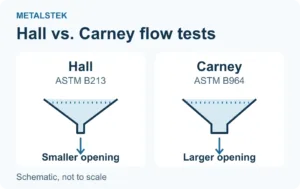
A supplier reports 15 seconds for a metal powder. Another reports 9 seconds for the same nominal grade. Before comparing the quotes, ask which funnel each lab used. A shorter time through a Carney funnel cannot establish that the powder would empty faster through a Hall funnel. It might not flow through the Hall funnel at all.
Put the funnel method and sample condition on the purchase order. Then specify what the receiving inspector should do if the powder will not discharge. Those details make a metal powder flowability result on a certificate of analysis (CoA) usable for lot acceptance.
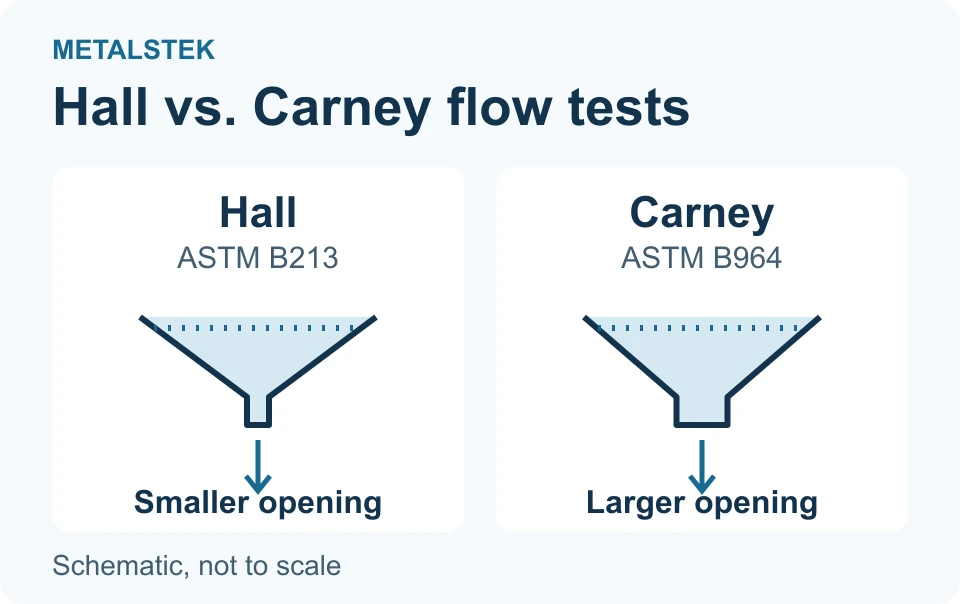
What a funnel test measures
Hall and Carney tests measure how long a specified mass of metal powder takes to discharge through a funnel under the conditions of the method. Reports commonly use seconds per 50 grams (s/50 g). For comparable samples tested by the same procedure and funnel, fewer seconds mean faster discharge in that test. The value does not describe how evenly a machine will spread the powder or how it will feed from a production hopper. ASTM B213 and ASTM B964 define the two laboratory methods.
Hall flow when the powder discharges through the Hall funnel
Use ASTM B213 as the starting point for metal powder that flows readily through the Hall funnel. If a drawing or purchase specification calls for Hall flow, request the test designation and revision on the CoA along with the measured time and unit. Take particular care with legacy specifications that say only “flow rate” or “fluidity.” Some tantalum powder grades, for example, have a fluidity column in the product data. Confirm the measurement method before transferring a catalogue value into a receiving limit.
Carney flow when the powder will not discharge through Hall
ASTM B964 uses a Carney funnel with a larger outlet. It gives a measurable time for some powders that will not flow through the Hall funnel. If the purchase agreement allows this route, retain the Hall outcome and record the Carney result in a separate field. For a comparison that includes both Hall-flowing and non-Hall-flowing powders, B964 also describes the use of a common Carney method. Compare those Carney results within that set. Carry the Hall result separately where the purchase specification requires it. ASTM B964.
How to read “no flow” on a report
“No flow” identifies the outcome of a test performed under a stated procedure. Record it under the relevant method. A blank entry may mean the lab did not test the sample, so ask which case applies. A zero in a numeric field can be mistaken for instantaneous discharge. Keep an explicit status for “no flow” and a separate status for “not tested,” even if purchasing software uses a numeric field for time.
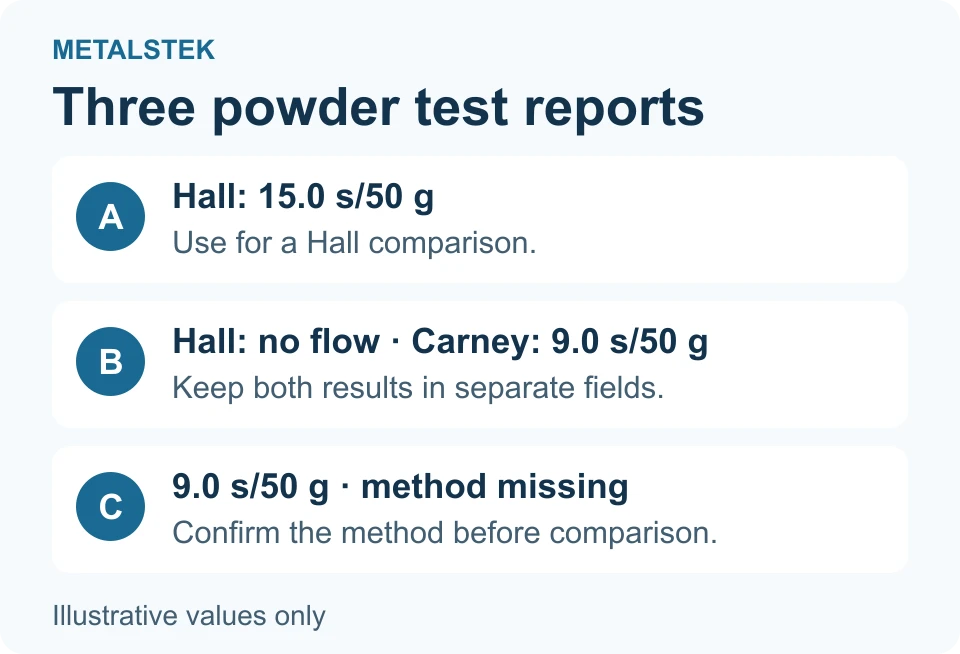
Consider three fictional CoA entries for the same nominal grade. Report A gives 15.0 s/50 g by Hall. Report B gives “no flow” by Hall and 9.0 s/50 g by Carney. Report C gives 9.0 s/50 g without a method. A has a usable Hall result. B has a usable Carney result and a documented Hall outcome. Ask for the method behind C before using it. If the purchase order requires Hall discharge, a report with only a Carney time cannot satisfy that condition. If the order allows a Carney fallback, evaluate B against the agreed Carney criterion.
What can shift the result between lots or labs?
Particle size distribution, shape, and surface condition can influence how particles move past one another. Fine particles and cohesive blends can have difficulty discharging through a small opening. Storage and handling also matter. In a published study on metal powders for additive manufacturing, the authors used the Carney funnel after their aluminum alloy and tantalum samples failed to flow through Hall. That result applies to the tested samples. A grade name alone cannot tell you which funnel will work for your lot. Test study on powder handling and storage.
Start an investigation with the sample history. A scoop from the top of one container may miss segregation elsewhere in a shipment. Agree with the supplier on how the lot will be sampled and how the test portion will be obtained. If results disagree, compare the revision, apparatus, sample condition and handling records before comparing the numbers. Document any agreed conditioning and any deviations. For example, testing powder after a drying step changes the sample condition from the as-received state. ASTM B215 sampling practices.
When a funnel result needs a process trial
Funnel flow is useful as a receiving check once it has been related to the process. In powder metallurgy, it can help monitor consistency in material intended for die filling. For laser powder bed fusion, the recoater moves powder across a surface in a thin layer. Powder behavior there depends on the spreading system and conditions. If layer coverage or uniformity is the risk, qualify those outcomes on the intended equipment or a representative spreading setup. NIST’s spreading testbed studies particle motion under that kind of setup. NIST AMS 100-58.
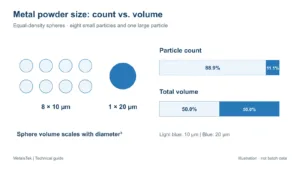
Keep flow time, apparent density, and particle size on separate lines in the specification. Apparent density describes the mass per bulk volume of loosely filled powder and can matter when a process meters by volume. Particle size data describe the distribution. Two lots with similar median particle size can still differ in the amount of fines, particle shape, or handling condition. Specify the grade and size range before setting a flow limit, particularly when comparing fine and coarse molybdenum powder grades. See the metal powder particle size guide for help writing the size requirements.
How to put flowability on a purchase order
Use a separate specification line for the funnel test. An engineering team qualifying a new grade can request a report-only result on trial lots, compare it with feeding or spreading performance, and then set a method-specific limit when supported by the data. For an established grade, state the relevant limits up front. Define whether a fallback is allowed and who can release a lot after a “no flow” outcome. This keeps an alternate test from becoming an informal substitute for the agreed release method.
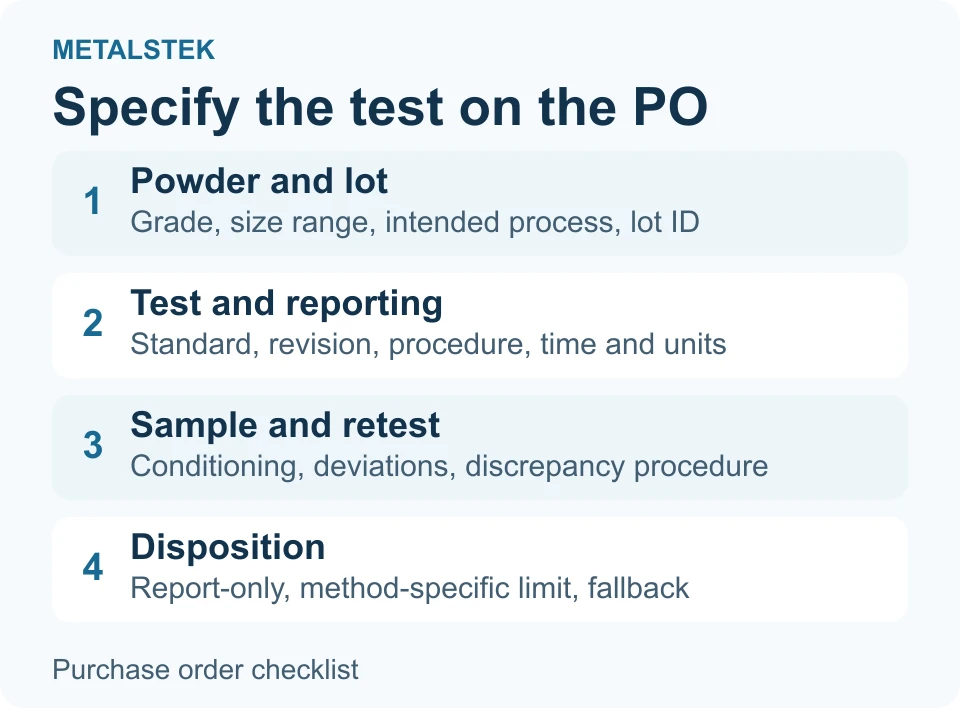
- Identify the powder. Give the material, purity or grade, particle size range and intended process. Include the lot number on the delivery documentation.
- Name the test. State the standard and revision, the method or procedure if applicable, and how the lab must report the time and units.
- Define sample condition and retest. Specify as-received or agreed conditioning. Record any deviations and agree on the action if supplier and receiving results differ.
- Set the disposition rule. State report-only or the applicable limit. If a Hall failure to discharge triggers Carney testing, identify the Carney criterion separately and retain both results.
For example, a trial order might ask for B213 at the agreed revision on an as-received sample, with the lot number on the report. If discharge fails, the vendor would record “no flow” under Hall and, with the agreed fallback, report B964 separately. The purchasing record can then be compared against the actual process trial before a limit is set.
Frequently asked questions
Can I convert a Carney time into a Hall time?
There is no general conversion. Outlet geometry changes the test, and a powder that runs through Carney can return “no flow” through Hall. Compare data obtained with the same method and comparable conditions.
Does a Hall “no flow” result mean I should reject the lot?
Check the purchase agreement before releasing the lot. If it requires Hall discharge, follow the nonconformance procedure. If it permits a Carney test or an engineering review, take that route and keep the original Hall result in the record.
Should I require a CoA result for every lot?
Require a lot-specific result if flow is a release criterion or an input to process control. During development, a report-only result on each trial lot can help establish which variation matters. Catalogue values are useful during selection and should be labeled separately from lot results.
Can a funnel test predict recoater performance?
It can flag changes in a qualified supply, but a funnel test omits the recoater and the layer geometry. Check layer coverage on a representative setup when you change powder grade, spreading hardware, or other relevant conditions.
What should I do when the lab changed the test method?
Record the change and compare like methods. If an acceptance limit depends on the old method, agree on a documented bridge study or revisit the limit with quality and engineering before switching.
Request a metal powder quotation with a defined flow test
Send MetalsTek the material, purity, particle size range, quantity, and application. Include the funnel standard and revision, sample condition, any required limit, and whether Carney is allowed when Hall gives no flow. If flow is report-only while you qualify the material, flag that in the request so the supplier can confirm what can be reported for the trial lot. Browse the metal powder catalogue for available materials or submit a powder RFQ.