A quotation for “20 µm metal powder” leaves an important question unanswered: does 20 µm describe a median, a sieve opening, or an upper limit? Two suppliers can quote that description and offer powders with substantially different distributions. A receiving laboratory may then report a third result if its measurement method differs.
A useful metal powder particle size specification connects the required distribution to a defined measurement procedure. This guide explains how to read D10, D50 and D90, why mesh classifications are different, and what to include in a purchase specification. The numerical examples are illustrative calculations, not MetalsTek batch measurements or recommended product limits.
Read the distribution basis before the diameter
The letter “v” in Dv50 identifies a volume-based distribution. Dv50 is the diameter below which 50% of the measured particle volume lies. Dv10 and Dv90 mark the corresponding 10% and 90% thresholds. Dn50 uses particle count instead. A report that says only “D50” needs its distribution basis confirmed. HORIBA’s guide to distribution calculations distinguishes these statistics and explains why a median differs from a mean.
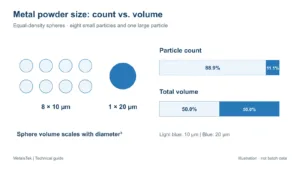
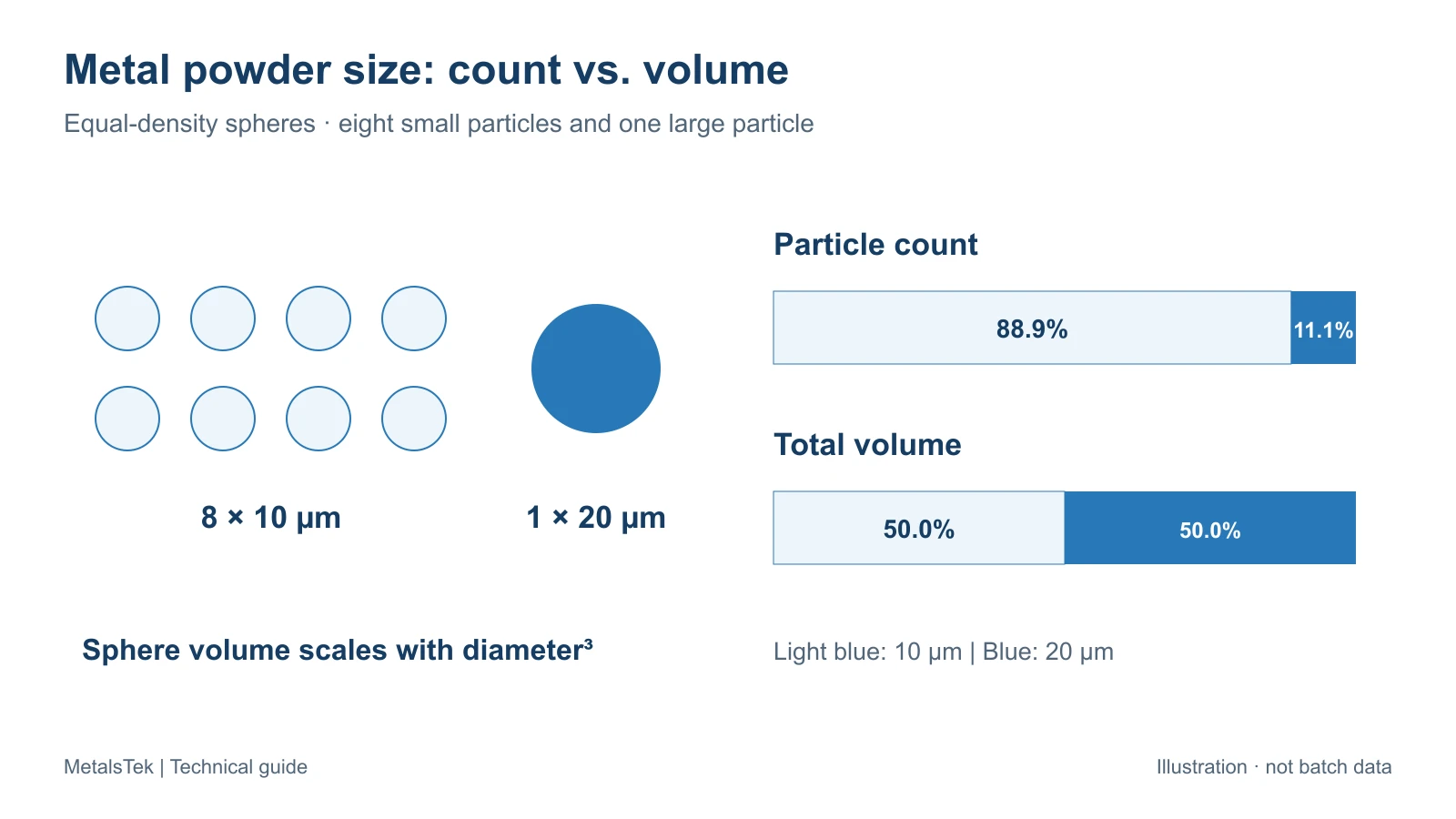
For equal-density spheres, one 20 µm particle has the same volume as eight 10 µm particles. In that nine-particle population, the eight small particles dominate the count but contribute only half the total volume. This geometric example explains why number and volume distributions answer different questions. A volume distribution is equivalent to a mass distribution only when particle density is constant; that assumption deserves attention when comparing mixtures.
Laser diffraction derives a distribution from light scattering using an optical model. Its reported equivalent-sphere diameter does not directly measure every particle’s longest dimension. The Malvern Panalytical description of laser diffraction explains the model and optical inputs. Record the model used when comparing laboratory reports.
D50 alone leaves the fine and coarse fractions unresolved
A median can be useful for tracking the middle of a distribution, while concealing changes elsewhere. Consider two invented volume-based datasets:
| Illustrative distribution | Dv10 | Dv50 | Dv90 | Span |
|---|---|---|---|---|
| A: narrower | 12 µm | 20 µm | 33.3 µm | 1.07 |
| B: broader | 5 µm | 20 µm | 80 µm | 3.75 |
Both have the same median. Their fine and coarse percentiles differ substantially. Here, span is calculated as (Dv90 − Dv10) / Dv50, using unrounded underlying values for A. The plotted curves are synthetic lognormal cumulative distributions. They demonstrate the arithmetic without implying that a real powder must follow that distribution.
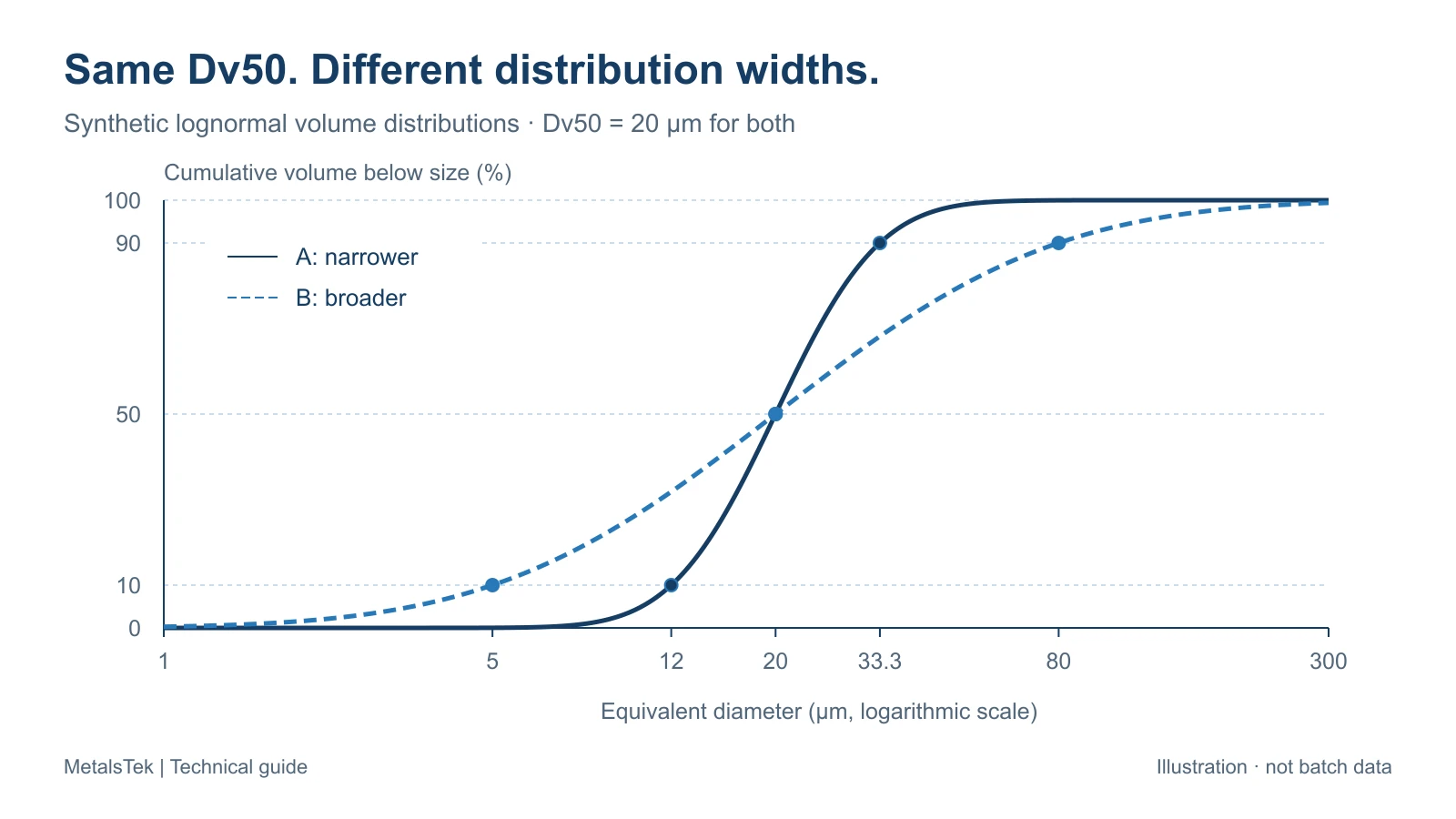
Dv90 is not a maximum particle size: approximately 10% of the measured volume lies above it. If an application requires control of material above a particular threshold, specify that fraction explicitly and agree how it will be measured. Request the full distribution when shoulders or multiple populations matter. A few percentiles cannot uniquely describe every curve, as the Malvern particle characterization guide illustrates.
Mesh classification and laser diffraction measure different things
Sieving separates particles according to passage through physical openings. Results are commonly reported as mass retained or passing. Laser diffraction reports a model-derived size distribution, usually on a volume basis. Particle shape can therefore create differences between the results, even when both laboratories have followed their procedures correctly. Malvern’s comparison of sieving and laser diffraction discusses this mismatch for non-spherical particles.
A mesh designation needs a named sieve standard and aperture. Do not convert a catalogue mesh label directly into Dv50. For an illustrative sieve fraction described as 15–45 µm, ask which apertures define the fraction and what residual undersize and oversize are permitted. Treating the label as proof that every particle lies between those dimensions would add an acceptance condition the supplier may never have offered.
When reviewing tungsten powder, request the sizing method attached to the quoted grade. If a legacy specification uses sieves, retain that acceptance method until a documented comparison supports a change. Agreement on a conversion should identify the material and morphology covered.
Specify the dispersed state and sample preparation
Particle size can change during preparation because clusters separate, or because the particles themselves are damaged. The measurement procedure must define what is being characterized: the powder in a specified dispersed state or the particles after a validated deagglomeration procedure.
Dry dispersion
Compressed-air pressure affects how a dry sample disperses. Increasing pressure may separate agglomerates, but excessive energy can break fragile particles. A smaller reported diameter does not, by itself, prove a better measurement. Malvern’s dry-method development guidance describes pressure studies used to assess dispersion. Ask for the approved preparation settings and method revision; avoid prescribing a universal pressure for different metals.
Wet dispersion
The liquid must wet the material without dissolving or otherwise altering it during measurement. Additives, mixing and sonication can affect dispersion. The manufacturer’s wet-method guidance explains these choices. Specify the liquid and any additives, along with the treatment used. Wet and dry results should be treated as different methods until their comparability has been established for the powder concerned.
Sampling and reporting belong in the purchase agreement
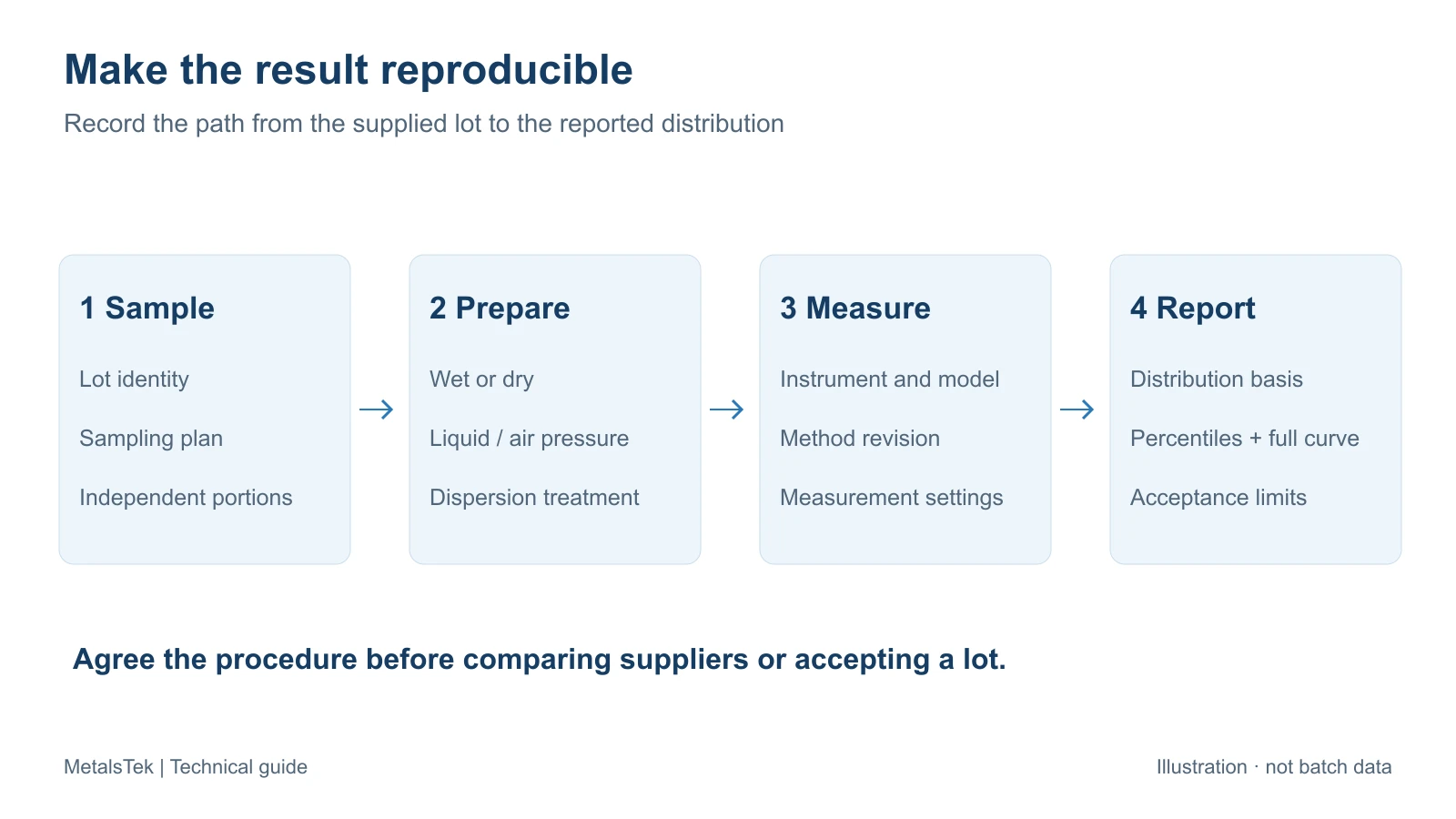
A precise instrument cannot correct a sample that does not represent the lot. Powders can segregate during handling, so a small scoop from one location may give a misleading distribution. HORIBA’s sampling white paper describes representative sampling and sample division. Agree how the laboratory portion will be obtained, how many independently prepared portions will be tested, and how results will be reported.
A lot-specific report should identify the supplied lot, sample, test method and measured values. A catalogue range is an offer description; a purchasing limit is an agreed acceptance requirement. Keep those entries separate on the RFQ. For repeat purchases of molybdenum powders, reference the approved specification revision rather than relying on the previous product name alone.
Request enough procedural detail to investigate a disagreement. Instrument and dispersion unit, optical settings, concentration conditions and preparation details all help another laboratory reproduce the analysis. Malvern’s reporting guidance identifies information that is often missing. Agree a retest procedure before shipment, including retained samples and how conflicting results will be reviewed.
A practical RFQ checklist for metal powders
Use the following fields to turn a size description into a reviewable request. Enter application-derived limits where available. Where limits are still being developed, ask the supplier to propose an available grade and supporting data for evaluation.
| RFQ field | Information to provide or confirm |
|---|---|
| Material | Composition, purity basis and relevant impurity limits |
| Size requirement | Percentile limits or sieve fractions, units and distribution basis |
| Tail control | Allowed fraction below or above specified thresholds, if required |
| Test procedure | Method, revision, instrument and preparation conditions |
| Sampling | Lot definition, sampling plan and independent preparations |
| Other properties | Morphology and any separately specified flow, density or oxygen tests |
| Delivery records | Lot-linked results, full distribution and agreed retest process |
| Commercial scope | Quantity, packaging, application and required delivery |
Particle size alone does not establish suitability for an application. For example, a request for tantalum powder should identify whether the application is metallurgical, additive manufacturing or capacitor-related research. Any application-specific performance requirements need separate review. Do not infer electrical performance or processing behavior from a matching Dv50.
Frequently asked questions
Does D50 mean the average particle diameter?
D50 is a median on the stated distribution basis. A mean is a different statistic and can differ from the median. Ask the laboratory to identify both the statistic and the weighting whenever a report uses the word “average.”
Does D90 mean all particles are smaller than that size?
No. For a volume distribution, Dv90 leaves approximately 10% of the volume above that diameter. Specify an oversize fraction and measurement procedure if the coarse tail is important to acceptance.
Can I replace a mesh requirement with laser diffraction?
Only after reviewing the methods for the material and agreeing the revised acceptance criteria. The two techniques use different physical definitions of size, and particle shape can affect their relationship.
Is the lower D50 result always the more accurate one?
No. Check sampling, dispersion and analysis settings before interpreting the difference. The lower value may reflect separated agglomerates, particle damage or another methodological difference. Compare results under a documented procedure.
What should accompany a custom powder quotation?
Ask for the offered material grade, defined size requirement, measurement basis and method, quantity and packaging. Confirm which lot-specific records will accompany delivery and which properties still require application evaluation.
Request a powder specification review
Send MetalsTek your material, intended process, quantity and particle size requirement. Include the current test method, example distribution report and any fine or coarse fraction limits. Submit a custom powder RFQ to review available grades and the documentation needed for your purchasing specification.