A replacement evaporation boat can match the old part’s length and still fail to reach the required deposition rate. The new tabs may seat at a different depth, the pocket may sit off center, or the heater may draw a different load from the same supply. If the evaporant spreads toward a clamp or reacts with the boat, even a mechanically correct replacement can shorten a run or change the film.
For a thermal evaporation boat replacement, start with the fixture drawing and the last stable run. Keep the boat material separate from the material you evaporate. A tungsten boat loaded with aluminum is a tungsten heater and an aluminum source; each needs its own specification. If you already have a part number, compare the drawing before treating another boat with the same overall dimensions as a drop-in replacement.
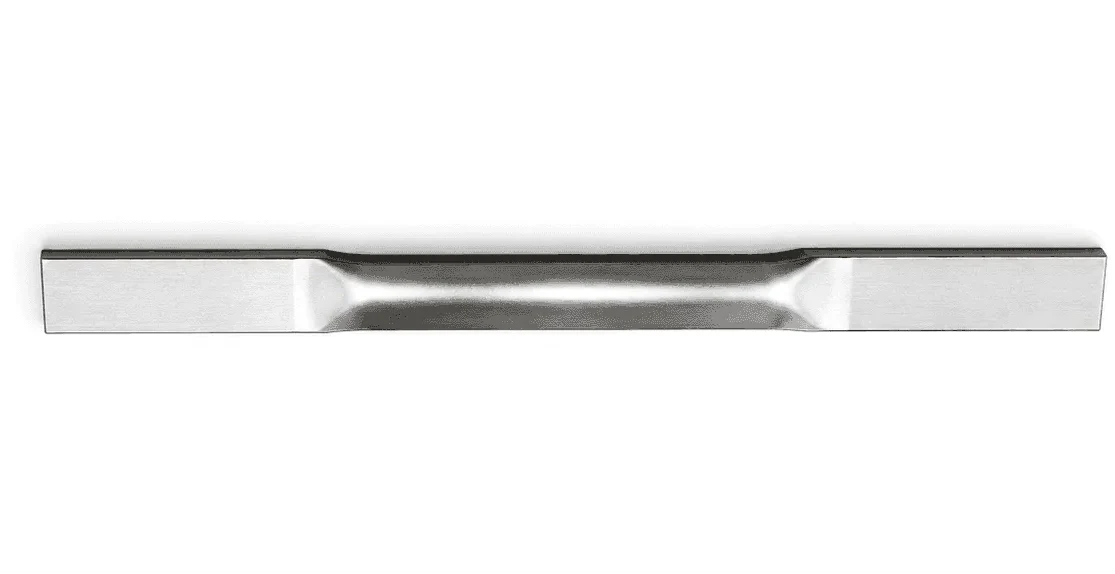
Measure the boat in the fixture
In a resistive source, current travels from one contact through the boat to the other. The strip heats and transfers energy to the charge in its pocket. Columbia’s thermal evaporator description shows how that principle is used in a laboratory tool. A furnace tray with a similar outline is a different purchase: it can hold a charge without being designed to carry source current.
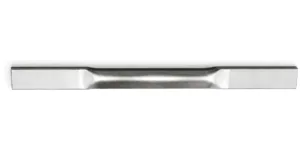
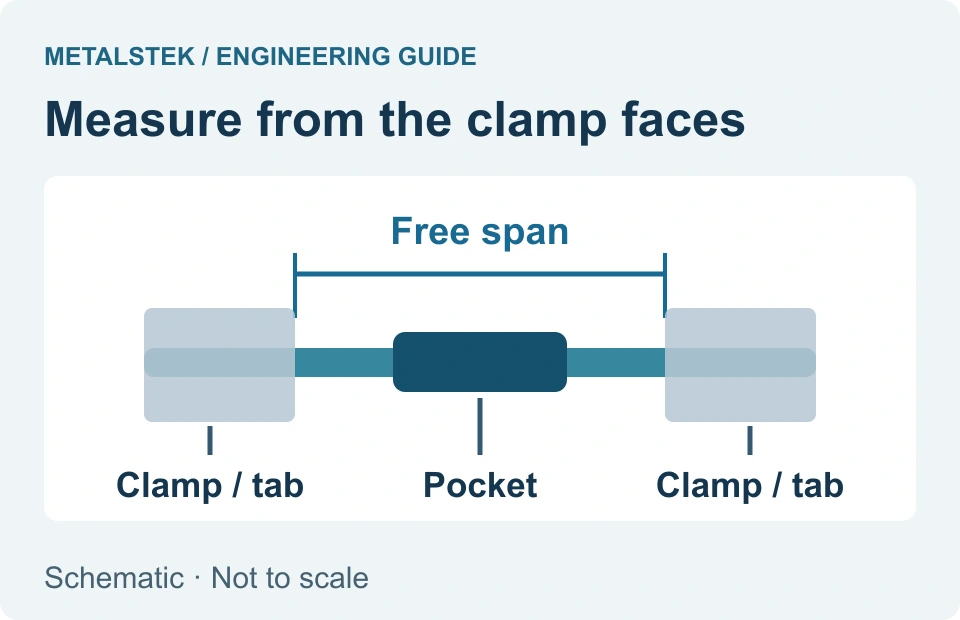
Record the distance between the inner clamp faces and the insertion depth at each end. Then measure tab width and thickness, the usable contact length, and any holes, slots or notches. A drawing should say whether its reference dimension is the free span between the jaws or the center-to-center distance between the posts. Those measurements are not interchangeable. Use an unused spare or the OEM drawing if the old part sagged, cracked or has residue on its contact faces.
Locate the pocket from a tab datum, and include its depth, opening and orientation. If it moves sideways or sits higher, it can lose clearance at the shield or sit differently relative to the shutter, substrate or thickness monitor. Send a side view for formed parts. It can reveal an offset or step that a plan view hides.
Check the supply before changing the strip
The boat is an electrical load. The simple relation P = I²R describes power dissipated in a resistance at a given current. It doesn’t tell you the boat temperature or evaporation rate. Resistance varies with temperature and geometry, and the actual current depends on the supply and the rest of the circuit. For a uniform solid strip at one temperature, increasing cross-sectional area reduces resistance; a formed boat adds changes in section and a temperature gradient that the simple strip calculation misses.
A thicker strip can therefore be a different load even when it fits the same jaws. Ask for the available voltage and current range, the supply mode or transformer tap if applicable, and the envelope the equipment manufacturer permits. Then request the supplier’s electrical data for the actual geometry, with the measurement conditions. UCSB’s Thermal Evap 1 equipment notes show one tool using transformer taps and a crystal rate monitor. Lesker’s flat-boat tables give an independent example: nominally similar outlines are listed with different electrical data. Those listings describe specific sources and conditions and cannot be transferred to a replacement on another machine.
If cold resistance is part of receiving inspection, agree on the temperature, probe positions and method. When the resistance is very low, a four-wire measurement can reduce lead resistance error. A measurement across the installed assembly can include the contact interfaces. Mark the probe positions on the drawing if the value will be used to reject parts, and keep an in-spec sample or a supplier baseline.
Choose the heater material and pocket together
The material pair matters at the required deposition rate and over the time the charge remains hot. Check whether the evaporant wets the heater, spreads beyond the pocket, or reacts with the boat. Also ask what a failed boat would introduce into the film. The Lesker deposition chart is useful for screening source types by evaporant. Treat its recommendations as a starting point. The geometry, duty cycle and contamination allowance still belong to your process.
Aluminum explains why. Angstrom Engineering documents molten aluminum wicking toward contacts and forming brittle reaction products with refractory metal boats. A bare boat that survives one deposition may fail on a later cycle. If the process already uses a coated source, separate liner or dedicated heater, keep that requirement on the replacement drawing.
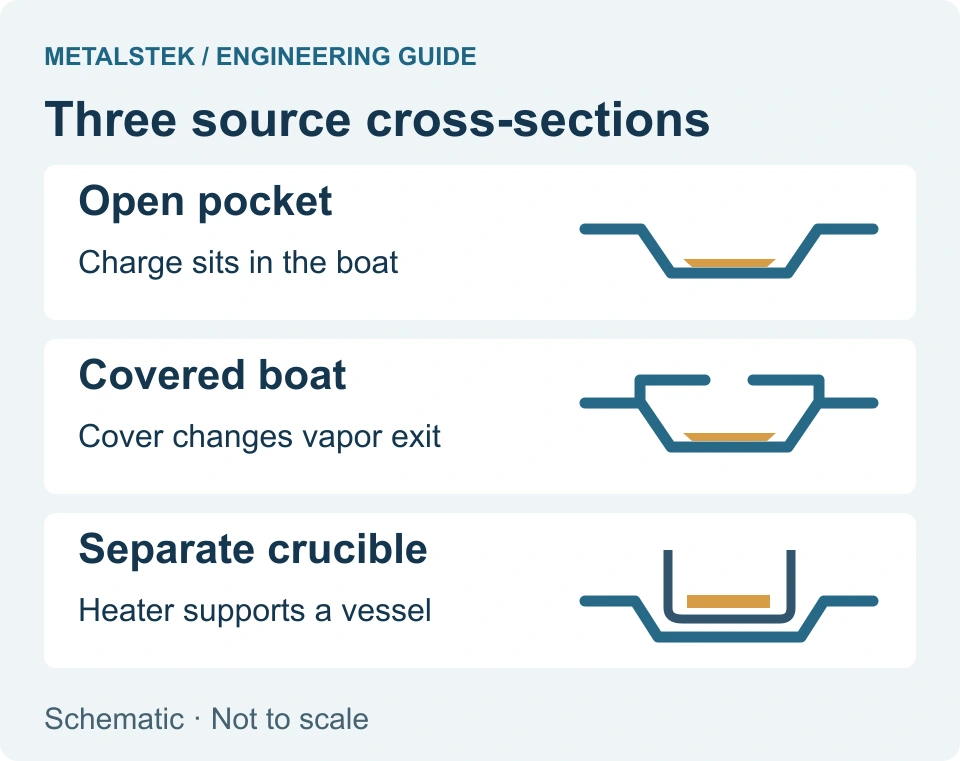
An open dimple or trough gives the charge a recess; check the loaded mass and how much room the melt needs. A cover can help contain ejected droplets for some materials, but it changes clearances, line of sight and loading access. A separately heated crucible keeps the charge in its own vessel and needs compatible heater support. Compare crucible and boat source types if the current source family is in doubt. The tungsten evaporation boat catalogue and molybdenum boat page give starting geometries; specify that you need a resistively heated source where a catalogue also includes trays.
Qualify one representative boat first
Start with an unpowered fit check by an authorized operator. Confirm that the contacts hold the tabs flat, the pocket clears nearby hardware and the center lands where the previous source sat. For the first deposition, use the site’s approved procedure and compare against a recent baseline for the same charge type, charge mass and intended film. Record the observed voltage and current at the target rate, how stable the rate is, any visible droplets and what remains in the pocket after the run.
If the new geometry changes the emitting region relative to the thickness monitor, recheck the tooling factor against a witness sample. The INFICON monitor manual describes comparing the monitor reading with actual thickness at the substrate holder. For film chemistry that matters to the device, agree with the process owner on a suitable witness-film check. Photograph the used boat and look for residue outside the pocket, distortion or contact damage. Use those observations alongside the electrical and film records; a crack alone does not identify its cause.
Use the qualification to decide what to check on receipt. For a repeat order you might check the tab dimensions and pocket position against the drawing, with the electrical and film checks reserved for an approved sample or a defined change in material, tooling or design. Ask the supplier to flag any change that affects the qualified configuration.
Example: the right outline, the wrong free span
Suppose two suppliers quote the same overall length. One drawing calls out the inner clamp spacing. The other shows only the distance between mounting post centers. Before comparing prices, ask the second supplier to show the jaws in section and locate both the pocket center and the points where the strip exits the jaws. If those dimensions differ, you have two designs to qualify, even though both drawings list the same length. This is a drawing review example, with no assumed dimensions or performance values.
Frequently asked questions
Can I order by overall length, width and thickness?
Use those dimensions to shortlist parts. A replacement requires the tab geometry, clamped span, pocket geometry and relevant clearances. Add the OEM part number or a marked fixture drawing when you can.
Should I choose a thicker tungsten strip to stop sagging?
Review the strip and hot-zone geometry with the supplier. Thickness can change both stiffness and electrical load. Loading, clamping and thermal cycling can also contribute to deformation. Change one variable at a time during qualification if the process permits.
Can I replace tungsten with molybdenum or tantalum?
Only after screening the evaporant and verifying the equipment’s load range. A material substitution can change both the electrical behavior of the source and how it reacts with the charge.
Does a deeper pocket always let me run a larger batch?
No. Available volume matters, but the permissible charge also depends on how the material wets the pocket and whether the source can hold the target rate without spillover or excessive distortion. Confirm the fill and run conditions with the equipment owner.
Request a quotation for a replacement evaporation boat
Send MetalsTek the old part number or drawing, tool model, clamp opening and free span, tab and pocket dimensions, heater material, evaporant and typical charge mass. Include the available electrical envelope, quantity and any coating or liner requirement. If you’re replacing a failed part, add a photo and describe where it failed. Submit a custom evaporation boat RFQ so the geometry and intended duty can be reviewed together.