Selecting an evaporation material is not simply a matter of choosing an element and the highest available purity. Reliable thin-film deposition depends on the material, deposition method, source geometry, crucible or boat, vacuum conditions, and the properties required from the finished film. This guide gives engineers and buyers a practical framework for specifying evaporation materials for thermal and electron-beam (e-beam) processes.
Buyer takeaway: define the deposition method, composition, purity basis, source form and dimensions, packaging, and documentation before requesting a quote. If the source material is being replaced in an established process, include the current source and crucible details so that the new lot can be matched as closely as practical.
What Are Evaporation Materials?
Evaporation materials are high-purity metals, alloys, oxides, fluorides, sulfides, and other compounds used as the source in physical vapor deposition (PVD). Under vacuum, the source is heated until atoms or molecules enter the vapor phase, travel through the chamber, and condense on a substrate. The resulting film may provide electrical conductivity, optical performance, corrosion resistance, diffusion control, reflectivity, or another engineered function.
Common applications include semiconductor and microelectronic layers, optical coatings, display components, photovoltaic devices, sensors, research samples, and decorative or protective coatings. MetalsTek supplies a broad range of high-purity evaporation materials and can support standard or custom source geometries.
Thermal Evaporation vs. E-Beam Evaporation
Both methods evaporate a source under vacuum, but they deliver heat differently. The best choice depends on vapor pressure, melting behavior, contamination tolerance, throughput, and the deposition system.
| Selection point | Thermal evaporation | E-beam evaporation |
|---|---|---|
| Heat delivery | Resistively heated boat, basket, filament, or crucible | Focused electron beam heats the charge locally |
| Typical fit | Materials that evaporate at temperatures compatible with the source assembly | Many high-melting-point metals and materials requiring concentrated heating |
| Source-material interaction | Contact with boat or crucible can influence contamination and wetting | Direct heating can reduce some contamination paths, but the hearth or liner must still be compatible |
| Process risks | Boat failure, alloying, poor wetting, or source reaction | Spitting, charge tunneling, unstable melt pool, or liner reaction |
| Best specification input | Boat/crucible material, power limit, charge size, and desired rate | Pocket dimensions, hearth/liner, beam power, charge size, and ramp/soak practice |
This comparison is a starting point rather than a universal recipe. Source compatibility and operating parameters are material- and system-specific. Always check the deposition equipment manual and a material-specific evaporation chart before committing a production process.
Main Categories of Evaporation Materials
Pure metals
Aluminum, gold, silver, copper, chromium, titanium, nickel, tantalum, tungsten, molybdenum, and other metals are used for conductive, reflective, adhesion, barrier, and functional layers. The process window varies widely: a method that works well for gold may be unsuitable for a reactive or refractory metal.
Alloys
Alloys can provide a target film composition or a combination of electrical, magnetic, optical, and mechanical properties. Because alloying elements may have different vapor pressures, the composition of the deposited film may not exactly match the starting charge. Process development or co-evaporation may be required when tight film stoichiometry is critical.
Oxides and other compounds
Oxides, fluorides, sulfides, and related compounds are widely used in optical and electronic films. Some compounds can dissociate, lose a volatile component, or change oxidation state during heating. The finished film chemistry may therefore depend on source composition, oxygen partial pressure, substrate temperature, and deposition rate. Specify the required film performance, not only the nominal source formula.
Choosing the Source Form and Size
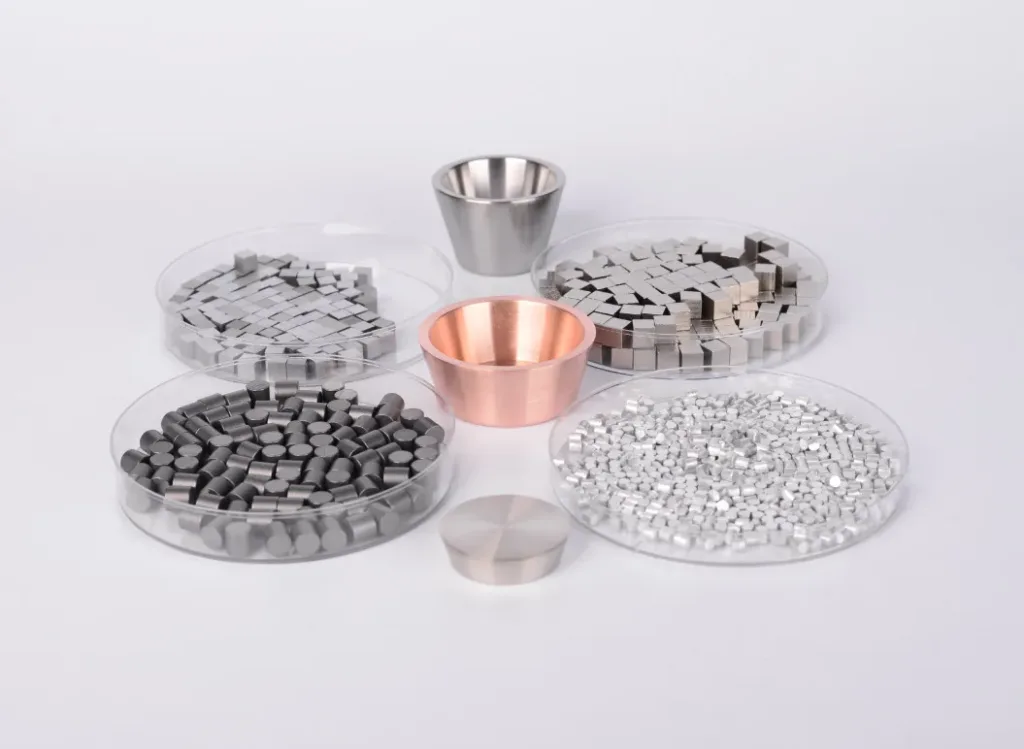
Evaporation materials are commonly supplied as pellets, granules, pieces, slugs, tablets, wire, rods, or shaped charges. There is no universally best particle size. The correct form should load safely, fit the source, couple efficiently with the heat input, and remain stable during ramp-up.
- Pellets and tablets: convenient, repeatable charge mass and relatively clean handling.
- Granules and pieces: conform to many crucible pockets and are available for a wide range of metals and compounds.
- Slugs and custom shapes: useful when the hearth pocket or production process requires a consistent geometry.
- Wire: suitable for selected thermal sources and controlled feeding systems.
- Powder: may be appropriate for specific compounds, but it can trap gas or eject particles if heating is too aggressive.
For e-beam systems, loose fines are not automatically easier to control. A stable, well-seated charge with an appropriate ramp and soak is generally more important than choosing the smallest available particle size.
How Much Purity Do You Need?
Purity is often expressed as 3N (99.9%), 4N (99.99%), 5N (99.999%), or higher. More nines can reduce the impurity contribution from the source, but the highest grade is not automatically the most economical or technically necessary. Chamber history, fixtures, substrate preparation, source compatibility, and handling can dominate contamination even when the charge is extremely pure.
- Start with the film’s electrical, optical, chemical, or reliability requirement.
- Identify critical impurities individually; total purity alone may hide a troublesome element.
- Confirm whether purity is reported on a metals basis, trace-metals basis, or another defined basis.
- Request a lot-specific certificate of analysis (CoA) when traceability matters.
- For alloys and compounds, specify acceptable composition and stoichiometry tolerances separately from total purity.
For aluminum source material, ASTM F1513 is one example of a material-specific standard addressing purity grades, physical attributes, analytical methods, and packaging. Do not apply an aluminum-specific standard to unrelated materials without review.
Crucible, Boat, and Liner Compatibility
The source container is part of the material system. A crucible or boat that is chemically attacked, wetted excessively, or thermally overstressed can contaminate the charge and shorten source life. Common source components include tungsten, molybdenum, tantalum, graphite, alumina, boron nitride, and other ceramics, but suitability depends on the evaporant and temperature.
Do not choose a liner by melting point alone. Consider chemical reactivity, wetting, thermal expansion, electrical behavior, and whether the evaporant is used molten or sublimed. MetalsTek offers evaporation crucibles and boats; provide the material, source dimensions, and deposition method so compatibility can be reviewed.
Packaging, Storage, and Handling
Good source material can be compromised between production and chamber loading. Packaging should reflect the material’s sensitivity and the cleanliness level of the application. Vacuum sealing, inert-gas packing, double bagging, clean containers, or protective oil may be used where appropriate. Reactive materials may oxidize or absorb moisture; soft materials can deform; powders can generate particulates.
- Keep the original lot label and CoA associated with the package.
- Store material in a clean, dry environment within the supplier’s recommended conditions.
- Use clean tools and compatible gloves; avoid mixing tools between materials.
- Open sensitive materials only when needed and minimize exposure time.
- Do not clean a source with an undocumented solvent or acid procedure.
Common Deposition Problems and What to Check
| Symptom | Possible contributors | First checks |
|---|---|---|
| Spitting or particles | Trapped gas, moisture, loose fines, rapid power ramp, contaminated charge | Review storage, preconditioning, ramp/soak, and charge packing |
| Unstable deposition rate | Changing melt geometry, beam position, poor thermal coupling, power instability | Inspect source loading, hearth/liner, monitoring, and power control |
| Unexpected film contamination | Source impurities, liner reaction, chamber memory, tooling, handling | Compare CoA, blanks, chamber history, and source-contact materials |
| Film composition drift | Different vapor pressures, compound dissociation, reactive-gas variation | Measure film chemistry and reassess source/process strategy |
| Cracked liner or short source life | Thermal shock, incompatible wetting/reaction, overfilling | Review fill level, ramp profile, liner selection, and cooling practice |
These checks are diagnostic starting points. Avoid changing several variables at once; record the lot, charge mass, source assembly, base pressure, ramp profile, rate, and run history so the actual cause can be isolated.
Evaporation Material RFQ Checklist
A complete request for quotation reduces technical back-and-forth and helps prevent a material that is chemically correct but physically unsuitable. Include:
- Material name, chemical formula, alloy composition, or grade.
- Required purity and any critical impurity limits.
- Deposition method: thermal, e-beam, or another process.
- Preferred form, dimensions, particle-size range, and tolerances.
- Crucible, boat, basket, filament, or hearth-pocket details.
- Required quantity, recurring consumption, and desired delivery schedule.
- Packaging requirements and environmental sensitivities.
- Required documentation: CoA, SDS, traceability, or inspection report.
- Application and required film properties, where disclosure is possible.
Why Source Evaporation Materials from MetalsTek?
MetalsTek supports research, pilot-scale, and production requirements with pure metals, alloys, oxides, and compound evaporation materials in standard and customized forms. Available options vary by material, but may include multiple purity levels, particle sizes, pellets, granules, pieces, slugs, wire, and custom geometry. Lot documentation and application-specific packaging can be discussed during quotation.
For the fastest technical review, send the RFQ checklist above together with your source dimensions and target film requirement. Our team can help match material form and supply documentation to the needs of your deposition process.