
A molybdenum blank can meet its nominal thickness and still be poorly specified for the next operation. A folded shield needs a forming review. A flat spacer needs defined dimensions and surface acceptance. Ordering both as “molybdenum foil, standard quality” leaves the supplier to interpret requirements that belong on the drawing.
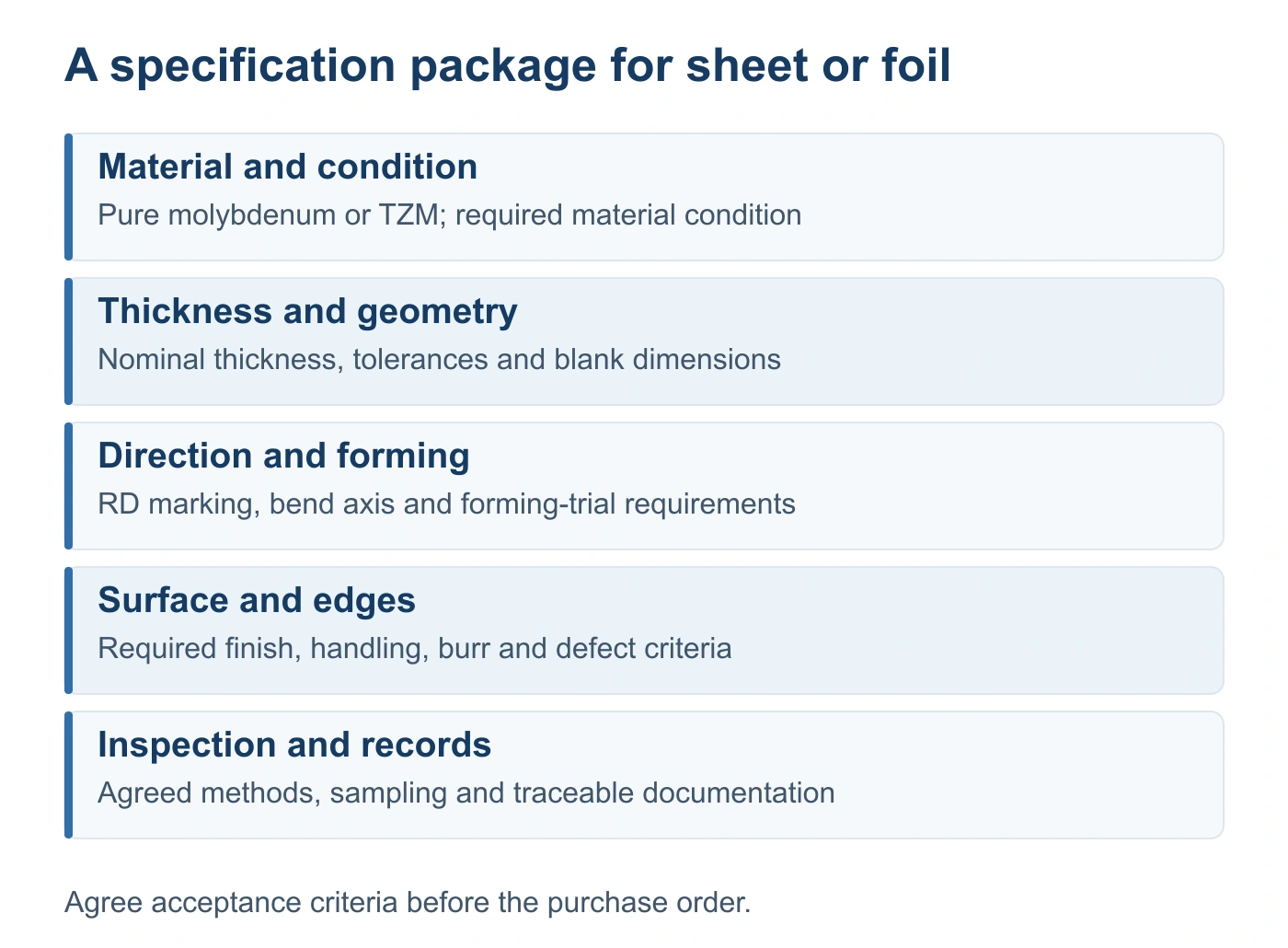
When buying molybdenum sheet and foil, specify thickness together with the material condition, usable dimensions and intended fabrication. Record rolling direction when orientation matters. This gives the quotation a defined scope and gives receiving inspection something objective to check.

Start with the dimensions of the supplied blank
Write thickness, width and length as separate dimensions, with units and allowed deviations. If the supplier is quoting a strip or coil, state its required width and how quantity will be expressed. For cut blanks, identify the finished blank size and whether a usable area must remain after edge trimming.
Keep the stock drawing separate from the formed-part drawing. A bend consumes developed length, while the finished component has an outside envelope and functional interfaces. Send both when the quotation includes forming, and identify which dimensions apply at each stage. The supplier should confirm who develops the blank and who accepts the final geometry.
For a thickness requirement that controls assembly fit, agree what the inspection report will show. Ask whether it will record individual readings, a minimum and maximum, or results from another agreed measurement plan. State any excluded edge zone and identify the area used for acceptance. An average reported without that context may leave the buyer unable to check the drawing requirement.
| Drawing item | What the purchase specification should state |
|---|---|
| Thickness | Nominal thickness, allowed deviation and the required measurement or reporting basis. |
| Width and length | Blank dimensions, tolerances and any guaranteed usable area. |
| Flatness and camber | Acceptance limits, the support condition and the inspection method. |
| Edges | Cutting responsibility, burr acceptance, trimming allowance and any required edge preparation. |
| Surface | Required finish, cleanliness and limits on marks in functional areas. |
| Orientation | Rolling-direction identification and the required relationship to the part drawing. |
A tolerance taken from another catalogue needs review before it becomes a purchase requirement. For example, Elmet’s HCT molybdenum foil data assigns thickness tolerances by thickness and width bands. That is a grade-specific producer example. It does not establish the tolerance available for another molybdenum product or for a MetalsTek order.
Specify material condition alongside the grade
A grade designation and a purity requirement answer different questions from delivery condition. ASTM B386/B386M-25 covers molybdenum and molybdenum-alloy flat products and distinguishes grades and production routes. If that standard is required, identify the edition and requested grade, then agree any additional drawing requirements. A reference to the standard on an RFQ does not certify the offered batch.
Use condition terms that the supplier can confirm. Elmet’s sheet information lists stress-relieved and recrystallized products according to customer use and notes that finish options depend on thickness and width. Treat these as examples of variables to discuss. They do not define a single preferred condition for every shield, punched blank or formed component.
The word “annealed” needs a stated condition. Discuss recrystallization separately from stress relief; the two names should not be interchangeable drawing notes. Working history and heat treatment affect strength and ductility in molybdenum, as the IMOA handbook explains. Agree the state required for the proposed blank and subsequent fabrication.
Ask the supplier to identify the offered condition in the quotation and delivery documents. If TZM alloy is being considered, name it explicitly and review its requirements separately. Substituting an alloy while keeping the same drawing notes can leave the material basis ambiguous.
For a repeat order, retain the approved specification revision and material description. A photograph of the previous sheet cannot document its condition, test direction or acceptance limits. If those details were never agreed, use the next quotation to resolve them before treating the earlier order as a reference.
Show rolling direction and the bend axis separately
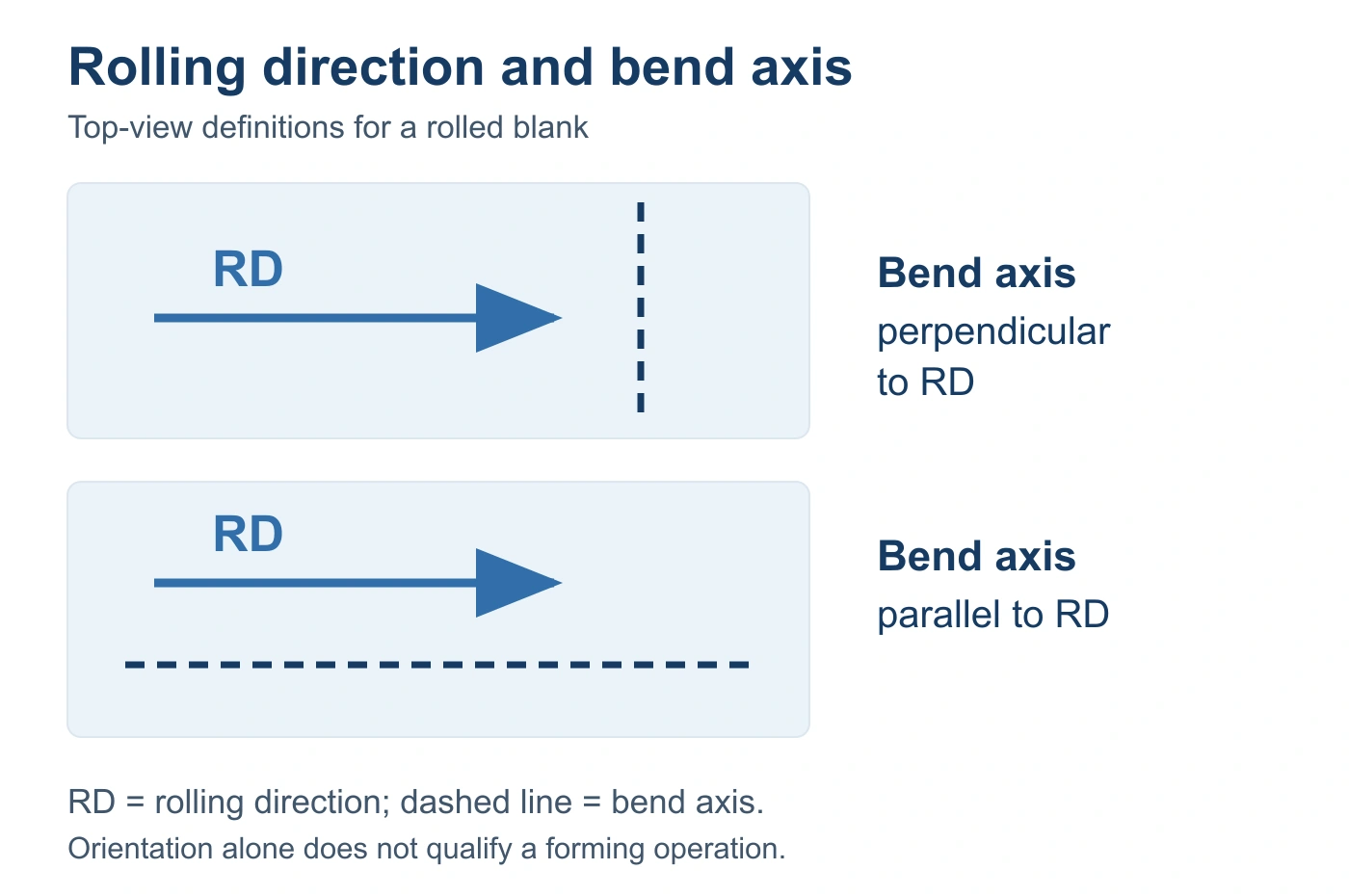
The IMOA molybdenum fabrication handbook reports a sheet test whose easier bending orientation had the primary rolling direction perpendicular to the bend axis. It also discusses directional behavior and cross rolling. The result belongs to the stated material and test conditions; it is not a universal cold-bending instruction.
On a drawing, use an arrow for rolling direction and a separate line for the bend axis. The axis is the line about which the sheet bends. Preserve that reference when marking and cutting blanks, and ask the supplier how orientation will be identified on delivered material. Do not infer it from a product photograph.
A part with bends in more than one direction needs the full geometry reviewed. Request a forming trial when the application requires evidence of bend performance, and agree the trial material, condition, orientation and acceptance criteria before production.
Agree how the material will be accepted
Convert functional needs into inspection instructions. If a blank must sit against a mating surface, define how flatness will be checked and what support is used during that check. If it will be trimmed after receipt, identify the area that must satisfy the drawing. The measurement arrangement should be reproducible by buyer and supplier.
The H.C. Starck PD-7028 sheet specification illustrates this level of definition. For its particular arc-cast product, it separately addresses delivery condition, tensile-test orientation, dimensions, camber, flatness and lot identification. Its numerical limits and test conditions belong to that product specification. Use the categories to structure a review, without transferring its limits to unrelated material.
If a mechanical property is an acceptance requirement, identify the test method, specimen orientation and material condition needed for its interpretation. Keep those details with the result when comparing a proposed substitute. For repeat production, ask how the supplied blanks will remain traceable to the relevant material and inspection records.
Describe surface requirements by purpose. A visible mark outside the usable area and a defect across a sealing or contact face have different consequences. Mark critical areas on the drawing and agree the inspection level. If a numerical roughness limit is needed, state the parameter and measurement arrangement; a finish name or photograph alone leaves room for interpretation.
Define which documents must accompany the shipment. A useful order may require a material certificate, agreed dimensional results and lot identification carried through to the cut blanks. Request the actual reports needed for your acceptance process. Do not assume that a nominal purity statement includes chemistry results, dimensional inspection or a forming trial.
Connect the flat-product order to the next operation
For a molybdenum boat or tray, provide the formed drawing as well as the proposed flat blank. Include wall and base geometry, bends, mounting details and any joint requirements. Ask the supplier to confirm the material and fabrication route offered for that geometry. A flat-product quotation covers only the operations included in its scope.
For custom molybdenum parts, identify whether cutting, hole making, edge preparation or forming is required before delivery. State the quantity of finished pieces and how unused stock or trial pieces should be handled. If the buyer will fabricate the parts, tell the supplier which operations are planned so that the proposed stock condition can be reviewed.
An illustrative RFQ can read: “Please review pure-molybdenum cut blanks to the attached drawing and revision. Confirm the offered grade and delivery condition. Quote the specified nominal thickness, dimensional tolerances, usable area, surface and edge requirements. Identify rolling direction. The blanks will be formed to the attached component drawing; confirm the proposed forming review or trial and the documents included.” Complete the drawing values before requesting a firm quotation.
Frequently asked questions
Is there one thickness that separates molybdenum foil from sheet?
Use the dimensions and specification as the purchasing reference. Product terminology can overlap in supplier listings, so “foil” or “sheet” alone is insufficient. Write the nominal thickness, units, allowed deviation and supplied form.
Should I order stress-relieved or recrystallized material?
Choose the condition through review of the intended fabrication and service requirements. Ask what condition is offered and how it is identified. Keep an approved condition on the drawing or purchase specification rather than leaving it as an informal preference.
How should rolling direction appear on the drawing?
Mark a direction arrow on the blank and show the bend axis separately. State the required relationship to the component geometry and how the orientation must remain identifiable after cutting.
Can I apply a published bend radius to any molybdenum foil?
A published bend result applies to its stated material, thickness, condition and test setup. Agree a forming review or trial for the proposed stock and part. Avoid treating a catalogue example as a general guarantee.
Which records should accompany a shipment of cut blanks?
Agree the required material identification, certification and inspection records before ordering. Specify whether dimensional results, orientation marking and traceability to the supplied lot are required. The quotation should identify what documentation is included.
Request a molybdenum flat-product review
Send MetalsTek the blank and component drawings, material requirements, quantity and required delivery date. Include thickness tolerance, delivery condition, rolling-direction needs and the inspection records required for acceptance. Submit your molybdenum sheet or foil RFQ so the proposed material and supply scope can be reviewed against the application.