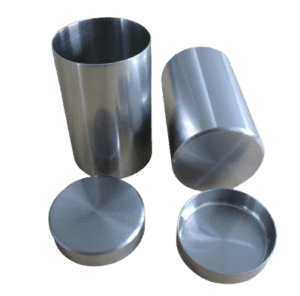
Zirconium Carbide (ZrC) is a distinguished member of the ultra-high-temperature ceramics (UHTCs) family. As industries push the boundaries of thermal limits—from aerospace propulsion to next-generation nuclear reactors—ZrC has emerged as a critical material. This guide provides a comprehensive technical overview of zirconium carbide powder, detailing its intrinsic properties, synthesis methodologies, and the cutting-edge applications that define its industrial value.
1. Introduction to Zirconium Carbide (ZrC)
Zirconium Carbide is a gray-black metallic refractory ceramic with a face-centered cubic (NaCl-type) crystal structure. It is characterized by a unique combination of covalent, ionic, and metallic bonding, which grants it the hardness of a ceramic alongside the thermal and electrical conductivity typical of metals.
In the landscape of refractory materials, ZrC is often compared to Hafnium Carbide (HfC) and Tantalum Carbide (TaC). While HfC possesses a higher melting point, ZrC offers a more favorable strength-to-weight ratio and better neutron absorption characteristics, making it indispensable in specific high-tech sectors.
2. Physical and Chemical Properties
The utility of ZrC powder is dictated by its extreme physical constants and chemical stability.
2.1 Thermal Properties
ZrC is prized primarily for its performance under intense heat:
- Melting Point: Approximately 3540°C ($6404°F$), though this varies slightly based on stoichiometry ($ZrC_x$).
- Thermal Conductivity: Unlike many ceramics that become insulators, ZrC maintains significant thermal conductivity ($\approx 20.5 \text{ W/m·K}$ at room temperature), which helps dissipate localized heat in high-speed friction environments.
- Thermal Expansion: It possesses a relatively low coefficient of thermal expansion ($6.7 \times 10^{-6}/K$), providing excellent dimensional stability.
2.2 Mechanical and Electrical Properties
- Hardness: ZrC is exceptionally hard, reaching 25–35 GPa on the Vickers scale. This makes it highly resistant to mechanical wear and erosion.
- Elastic Modulus: With a Young’s modulus of approximately 350–440 GPa, it is highly rigid.
- Electrical Conductivity: Due to its metallic bonding components, ZrC is an effective conductor, which allows for processing via Electrical Discharge Machining (EDM) when sintered into solid forms.
2.3 Chemical Stability
ZrC is highly resistant to chemical attack by many acids and alkalis at room temperature. However, it is susceptible to oxidation in air. At temperatures above 800°C, it begins to form $ZrO_2$ (Zirconia), which can lead to volume expansion and structural failure unless protected by coatings or used in inert/vacuum environments.
3. Production and Synthesis Methods
The quality of the final ceramic component is heavily dependent on the purity, particle size, and morphology of the starting ZrC powder.
3.1 Carbothermic Reduction
This is the most common industrial method due to its cost-effectiveness. Zirconium dioxide ($ZrO_2$) is mixed with high-purity carbon (black carbon or graphite) and heated in a vacuum or inert atmosphere.
$$ZrO_2 + 3C \rightarrow ZrC + 2CO$$
- Temperature: 1800°C to 2200°C.
- Pros: Suitable for mass production.
- Cons: Often results in larger particle sizes and potential oxygen/carbon impurities.
3.2 Direct Carbonization
Involving the reaction of metallic zirconium powder with carbon.
$$Zr + C \rightarrow ZrC$$
This reaction is highly exothermic and can be carried out via Self-propagating High-temperature Synthesis (SHS). It produces high-purity powder but is more expensive due to the cost of raw zirconium metal.
3.3 Chemical Vapor Deposition (CVD)
CVD is used to produce ultra-pure ZrC coatings or nano-powders by reacting gas-phase precursors, typically zirconium tetrachloride ($ZrCl_4$) and methane ($CH_4$).
$$ZrCl_4 + CH_4 \rightarrow ZrC + 4HCl$$
This method is essential for thin-film applications in the semiconductor and aerospace industries.
3.4 Sol-Gel Processing
The sol-gel method allows for the synthesis of nano-scale ZrC powder at lower temperatures. By mixing zirconium alkoxides with a carbon source at the molecular level, a precursor “gel” is formed, which is then pyrolyzed. This produces powders with exceptional sinterability.
4. High-Temperature Applications
The unique profile of ZrC powder makes it a “problem-solver” material for environments where standard metals and ceramics fail.
4.1 Aerospace and Defense
ZrC is a primary candidate for Hypersonic Flight and Rocket Propulsion.
- Rocket Nozzles: The extreme heat and erosive gas flow in solid rocket motors require materials that won’t melt or deform. ZrC-coated carbon-carbon composites provide the necessary protection.
- Leading Edges: Hypersonic vehicles experience temperatures exceeding 2000°C due to atmospheric friction. ZrC is used in Ultra-High Temperature Ceramic (UHTC) blends to maintain aerodynamic integrity.
4.2 Nuclear Energy
ZrC plays a pivotal role in TRISO (Tristructural-Isotropic) fuel particles used in High-Temperature Gas-Cooled Reactors (HTGR).
- Fission Product Barrier: In TRISO fuel, ZrC can replace or augment Silicon Carbide (SiC) layers. ZrC is more effective at high temperatures and acts as a superior diffusion barrier for metallic fission products like Cesium and Silver.
- Neutron Economy: ZrC has a low neutron absorption cross-section, making it efficient for use within a reactor core.
4.3 Cutting Tools and Wear Resistance
When added to alumina ($Al_2O_3$) or tungsten carbide ($WC$) matrices, ZrC powder enhances the hardness and thermal shock resistance of cutting tools. This allows for higher machining speeds when processing tough alloys like titanium or nickel-based superalloys.
4.4 Solar Energy
Because of its high absorption in the solar spectrum and low emissivity in the infrared, ZrC is researched as a Solar Selective Reformer. It can withstand the concentrated solar thermal energy required for high-efficiency solar-to-chemical energy conversion.
5. Sintering and Consolidation
Transforming ZrC powder into a functional part is challenging due to its high melting point and low self-diffusion coefficient. Pure ZrC is difficult to sinter to full density.
- Sintering Aids: Small amounts of additives like Cobalt, Nickel, or Chrome are sometimes used, though they may lower the overall melting point of the composite.
- Spark Plasma Sintering (SPS): This modern technique uses pulsed DC current and high pressure to achieve near-theoretical density at lower temperatures and in significantly shorter times compared to traditional hot pressing.
- Reactive Sintering: Combining Zr and C powders during the sintering process to use the heat of reaction to drive densification.
6. Challenges and Future Outlook
Despite its impressive properties, the widespread adoption of ZrC faces hurdles:
- Oxidation Sensitivity: Future research is focused on creating “self-healing” ZrC composites by adding SiC or $MoSi_2$, which form a protective glass layer upon exposure to oxygen.
- Fracture Toughness: Like most ceramics, ZrC is brittle. Incorporating carbon nanotubes or ceramic fibers (CMCs) is a major area of development to improve impact resistance.
- Cost: Reducing the energy requirements of the carbothermic reduction process remains a priority for industrial-scale viability.
7. Conclusion
Zirconium Carbide powder stands as a cornerstone of modern materials science. From ensuring the safety of nuclear fuel to shielding spacecraft during re-entry, its role in high-temperature technology is irreplaceable. As manufacturing techniques like 3D printing (Additive Manufacturing) and Spark Plasma Sintering evolve, ZrC will likely move from niche high-tech applications into broader industrial use, driving the next generation of thermal management solutions.
Technical Specification Summary Table
| Property | Value |
| Formula Weight | 103.22 g/mol |
| Density | 6.73 g/cm³ |
| Crystal System | Cubic (NaCl-type) |
| Vickers Hardness | 2500 – 3200 kg/mm² |
| Specific Heat | 37.8 J/mol·K |
| Color | Dark Gray/Black |