For engineers designing systems for extreme environments, material failure is not an option. When operating in High Vacuum Environments, aerospace propulsion systems, or ultra-high-temperature semiconductor furnaces, standard refractory metals often fall short. Thermal stress deformation, high-temperature oxidation, and catastrophic structural failure are constant threats that drive up maintenance costs and risk system integrity.
While pure tungsten boasts the highest melting point of all metals, it suffers from severe room-temperature brittleness and rapid recrystallization embrittlement when exposed to extreme thermal cycling. The solution lies in the “Rhenium Effect.” By alloying tungsten with rhenium, engineers can achieve unparalleled High-Temperature Creep Resistance alongside remarkable ductility.
As a thought leader in extreme environment materials science, Metalstek delivers ultra-high-purity Tungsten Rhenium Rods engineered through advanced Powder Metallurgy to meet the exact specifications of aerospace structural engineers and medical device developers.
The “Rhenium Effect”: Overcoming Thermodynamic Limitations
The addition of rhenium to a tungsten matrix fundamentally alters its thermodynamic and mechanical profile. Rhenium lowers the Ductile-to-Brittle Transition Temperature (DBTT) while simultaneously increasing the ultimate tensile strength and recrystallization temperature.
Through highly controlled Powder Metallurgy and Hot Isostatic Pressing (HIP), Metalstek ensures a uniform dispersion of rhenium, eliminating microporosity and maximizing the material’s theoretical density. This results in refractory metal components that maintain their structural integrity even when subjected to severe thermal shock.
Table 1: Key Thermophysical Properties of Tungsten-Rhenium Alloys
| Property | Pure Tungsten (W) | W-3%Re | W-25%Re |
| Melting Point | 3422°C | ~3380°C | ~3120°C |
| Density (g/cm³) | 19.25 | 19.35 | 19.70 |
| Recrystallization Temp. | 1200°C – 1400°C | 1400°C – 1600°C | >1600°C |
| Room Temp Ductility | Poor (Brittle) | Good | Excellent |
| Electrical Resistivity (μΩ·cm) | 5.5 | ~10 | ~25 |
Comparative Analysis: Tungsten Rhenium vs. Refractory Alternatives

When selecting high-temperature furnace materials or radiation shielding materials, senior procurement managers and R&D engineers must weigh thermal performance against machinability and lifecycle costs. Tungsten-Rhenium bridges the gap between the ultra-high thermal capacity of pure tungsten and the relative ductility of molybdenum.
Table 2: Horizontal Product Comparison (W-Re vs. Pure W vs. Pure Mo)
| Material Grade | Max Operating Temp | DBTT (Ductile-Brittle Temp) | High-Temp Creep Resistance | Machinability | Primary Use Case |
| Pure Molybdenum (Mo) | 1800°C | Near Room Temp | Moderate | Good | Standard vacuum furnace elements |
| Pure Tungsten (W) | 2800°C | 300°C – 400°C | High | Poor | High-temp heating elements, standard shielding |
| W-3%Re / W-5%Re | 2800°C | Below Room Temp | Very High | Moderate | Thermocouples, semiconductor furnace components |
| W-25%Re / W-26%Re | 2600°C | Well Below Room Temp | Exceptional | Moderate-Good | Aerospace structural parts, friction stir welding tools |
Critical B2B Applications for Tungsten Rhenium Rods
The unique matching of a low Coefficient of Thermal Expansion (CTE) with high ductility makes W-Re rods indispensable across several high-tech industries:
1. Semiconductor Equipment Engineering
In MOCVD (Metal-Organic Chemical Vapor Deposition) and ion implantation systems operating in High Vacuum Environments, materials must not outgas or deform. W-Re rods are used for structural supports and high-temperature heaters because their stable CTE prevents mechanical stress on delicate silicon or silicon carbide wafers during rapid thermal processing.
2. Aerospace & Defense Structural Components
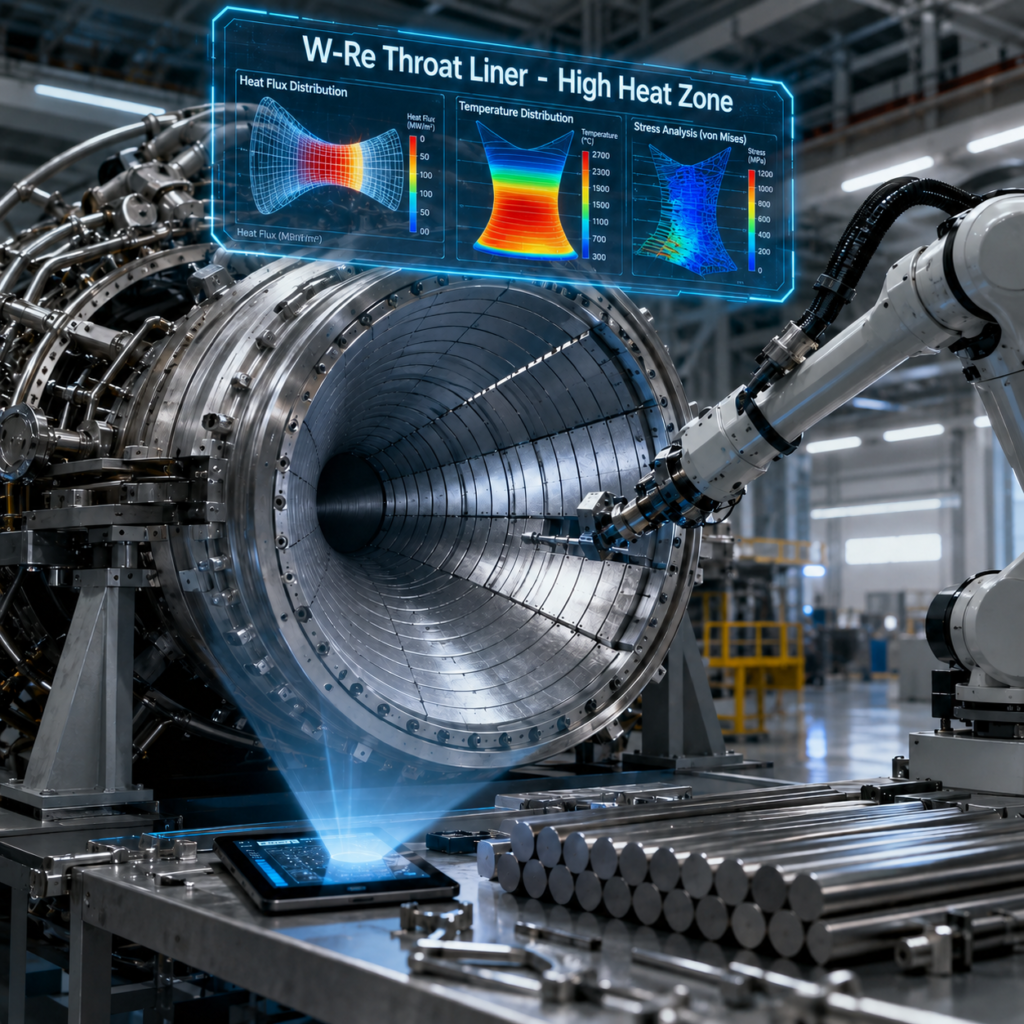
Aerospace structural engineers utilize W-Re alloys for high-temperature structural fasteners, rocket engine nozzles, and jet engine turbine components. The exceptional High-Temperature Creep Resistance ensures that these aerospace materials do not elongate or deform under the massive centrifugal and thermal loads of hypersonic flight.
3. Medical & Analytical Instruments
Due to its high density, Tungsten Rhenium is highly effective as a radiation shielding material. Furthermore, W-Re rods are critical in the manufacturing of X-ray tube targets, where the rhenium addition prevents the surface micro-cracking that typically occurs in pure tungsten targets under intense electron beam bombardment.
Table 3: Application Matrix and Required Material Grades
| Industry | Specific Application | Recommended W-Re Grade | Critical Success Factor |
| Semiconductor | MOCVD Heaters / Support Rods | W-3%Re, W-5%Re | Low outgassing, matched CTE |
| Aerospace | Rocket Nozzle Inserts | W-25%Re | Thermal shock resistance, high-temp strength |
| Medical | X-Ray Tube Target Shafts | W-10%Re, W-25%Re | Resistance to surface micro-cracking, radiation attenuation |
| Industrial | Friction Stir Welding (FSW) Tools | W-25%Re | Extreme hardness at elevated temperatures, wear resistance |
Precision Machining Challenges and the Metalstek Advantage
Refractory metals are notoriously difficult to machine. The very properties that make Tungsten Rhenium desirable—its extreme hardness, density, and resistance to deformation—also lead to severe tool wear, work hardening, and surface micro-fissures during conventional CNC machining.
How Metalstek Solves the Machining Challenge
As a specialized manufacturer, Metalstek eliminates the risk of component failure through a highly controlled, end-to-end manufacturing ecosystem:
- Ultra-High Purity Materials: We start with tungsten and rhenium powders refined to 4N (99.99%) or 5N (99.999%) purity. This eliminates interstitial impurities (like oxygen and carbon) that cause grain boundary embrittlement.
- Defect-Free Consolidation: Utilizing advanced Hot Isostatic Pressing (HIP), we achieve >99.5% theoretical density, ensuring there are no internal voids that could lead to catastrophic failure under stress.
- Advanced Precision Machining: We utilize state-of-the-art Electrical Discharge Machining (EDM), electrochemical machining, and diamond-tooled CNC turning to process Tungsten Rhenium Rods to extreme dimensional tolerances without inducing residual thermal stress or surface cracking.
- Traceable Quality Control: Every batch undergoes rigorous non-destructive testing (ultrasonic and X-ray inspection) and is delivered with a comprehensive, fully traceable material specification sheet.
Elevate Your Engineering with Metalstek
Do not let material limitations bottleneck your next-generation designs. Whether you are engineering the next wave of semiconductor fabrication equipment or developing hypersonic aerospace structures, Metalstek’s Tungsten Rhenium rods provide the ultimate safeguard against high-temperature creep and thermal fatigue.
Ready to overcome your toughest material challenges?
Submit your CAD drawings for technical evaluation, request a detailed material specification sheet, or contact our engineering sales team today to secure a competitive quote for your custom refractory metal needs.
Frequently Asked Questions (10 FAQs)
1. What is the main advantage of adding rhenium to tungsten rods?
The “Rhenium Effect” significantly lowers the ductile-to-brittle transition temperature (DBTT) of tungsten, making the alloy highly ductile at room temperature while vastly improving its high-temperature creep resistance and recrystallization temperature.
2. How does Metalstek ensure the high density of its Tungsten Rhenium rods?
We utilize advanced Powder Metallurgy combined with Hot Isostatic Pressing (HIP). This applies uniform high temperature and inert gas pressure, eliminating internal porosity and achieving greater than 99.5% of the theoretical density.
3. Are Tungsten Rhenium rods suitable for high vacuum environments?
Yes. Due to our 4N/5N material purity and extremely low vapor pressure at high temperatures, our W-Re rods exhibit virtually zero outgassing, making them ideal for ultra-high vacuum semiconductor and aerospace applications.
4. What are the most common tungsten-rhenium alloys available?
The most widely used commercial grades are W-3%Re, W-5%Re, W-25%Re, and W-26%Re. Lower rhenium content is often used for high-temperature wires and heaters, while higher rhenium content (25-26%) is used for structural parts requiring maximum ductility and thermal shock resistance.
5. How does the CTE of Tungsten Rhenium compare to pure tungsten?
The Coefficient of Thermal Expansion (CTE) of W-Re alloys remains extremely low and is highly comparable to pure tungsten. This makes it an excellent choice for applications requiring precise dimensional stability during extreme thermal cycling.
6. Why is Tungsten Rhenium used in Friction Stir Welding (FSW)?
FSW of hard metals like steel or titanium requires a tool that will not deform or melt at extreme frictional temperatures. W-25%Re provides the necessary combination of extreme high-temperature hardness, wear resistance, and toughness.
7. Can Metalstek machine Tungsten Rhenium rods into complex geometries?
Yes. While W-Re is highly challenging to machine conventionally, Metalstek utilizes specialized EDM, laser cutting, and diamond-tooled precision turning to achieve tight tolerances without inducing surface micro-cracks.
8. Is Tungsten Rhenium effective as a radiation shielding material?
Absolutely. With a density approaching 20 g/cm³, W-Re provides exceptional attenuation of X-rays and gamma radiation. Its added ductility makes it easier to fabricate into complex shielding geometries compared to pure tungsten.
9. How do Tungsten Rhenium rods perform under high-temperature oxidation?
Like pure tungsten, W-Re alloys will oxidize at high temperatures in the presence of oxygen. They are designed for use in protective atmospheres (such as argon or hydrogen) or in strict High Vacuum Environments.
10. How can I verify the quality and purity of Metalstek’s W-Re products?
Metalstek operates under a strict, fully traceable quality control system. Every order can be accompanied by a comprehensive Certificate of Analysis (COA) detailing the 4N/5N chemical purity, grain structure, and mechanical properties of the specific batch.