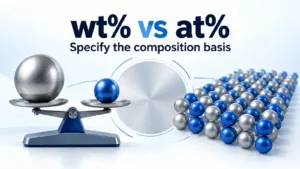
A request for a “Ti-Al 50:50 sputtering target” leaves a manufacturing question unanswered: does 50:50 describe mass or atom count? The two recipes contain substantially different amounts of titanium. Before a supplier can review the composition, the specification needs a basis.
For sputtering target composition, wt% means percentage by mass, while at% means percentage by number of atoms within a stated set of elements. Converting between them requires atomic weights. For oxides, you must also distinguish an oxide mixing ratio from a metal-cation ratio and an all-element atomic composition. Those distinctions belong on the RFQ, drawing and acceptance documentation.
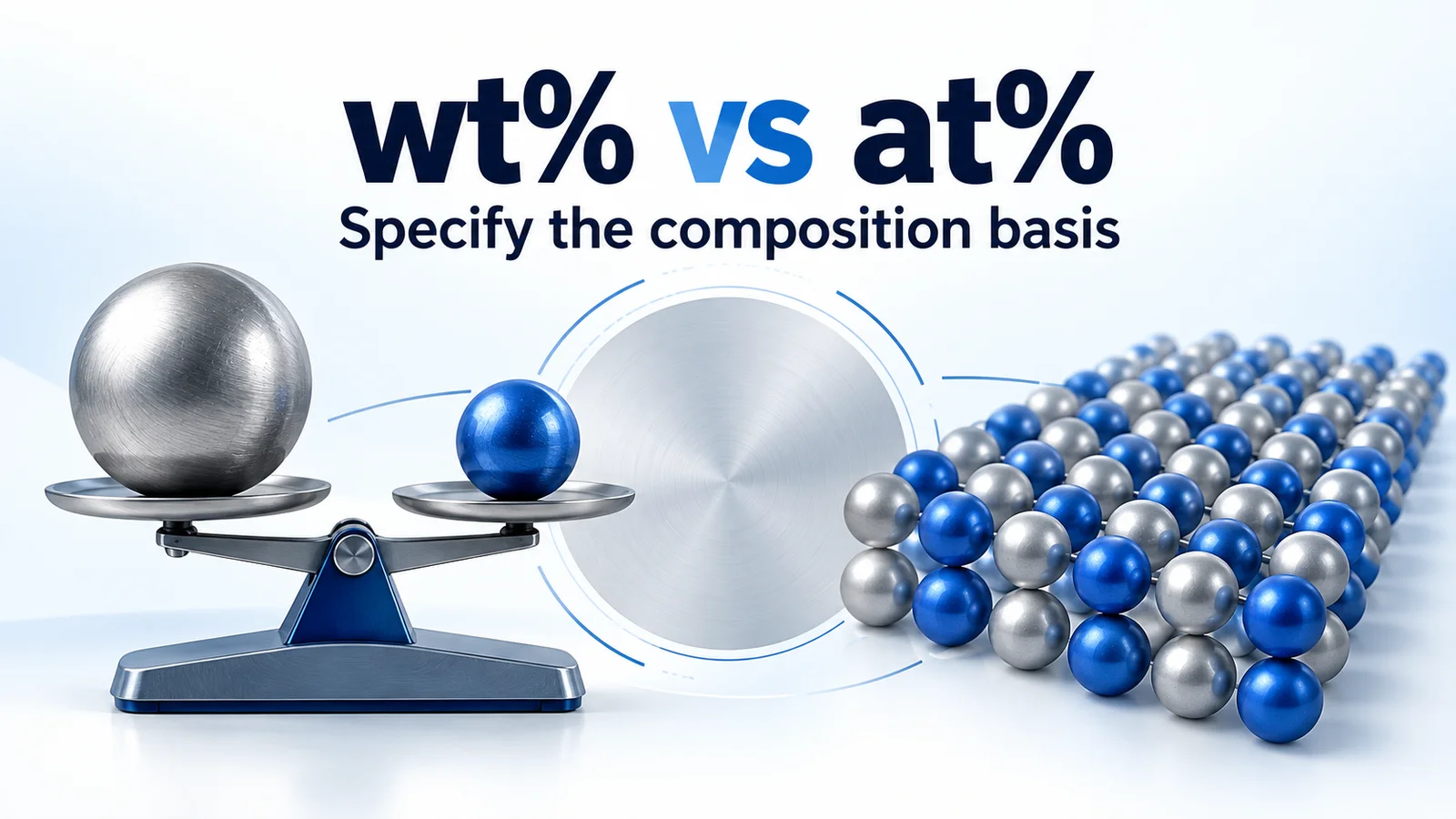
What wt%, at% and mol% actually specify
Weight percent, also called mass percent, assigns each constituent a share of the total mass. A nominal Ti-Al mixture containing 50 wt% Ti and 50 wt% Al contains 50 g of each element per 100 g of mixture. The word “nominal” identifies the intended composition; it does not establish an analytical result or a manufacturing tolerance.
Atomic percent counts atoms instead. An equiatomic binary mixture has equal numbers of the two kinds of atom. Because titanium atoms are heavier than aluminum atoms, an equiatomic Ti-Al mixture contains more titanium by mass. The IUPAC Green Book distinguishes mass fraction from amount fraction. Percent notation expresses either fraction multiplied by 100.
Mole percent needs the constituent entity to be named. For a mixture whose entities are individual elemental atoms, mol% and at% have the same numerical value. For a mixture described in moles of oxide formula units, they generally do not. One mole of In₂O₃ contains two moles of indium atoms and three moles of oxygen atoms.
How to convert wt% to at%
Divide each elemental mass fraction by its atomic weight, then normalize the resulting amounts. For ordinary elemental mixtures, use:
xᵢ = (wᵢ / Mᵢ) / Σⱼ(wⱼ / Mⱼ)
Here, wᵢ is the mass fraction, xᵢ is the atomic fraction and Mᵢ is the elemental molar mass, using consistent units. The numerical atomic-weight values provide the corresponding molar masses in g/mol to the precision used here. You can enter percentages directly instead of fractions if every constituent uses the same scale. Multiply the normalized result by 100 to report at%.
Worked example: two different Ti-Al 50:50 specifications
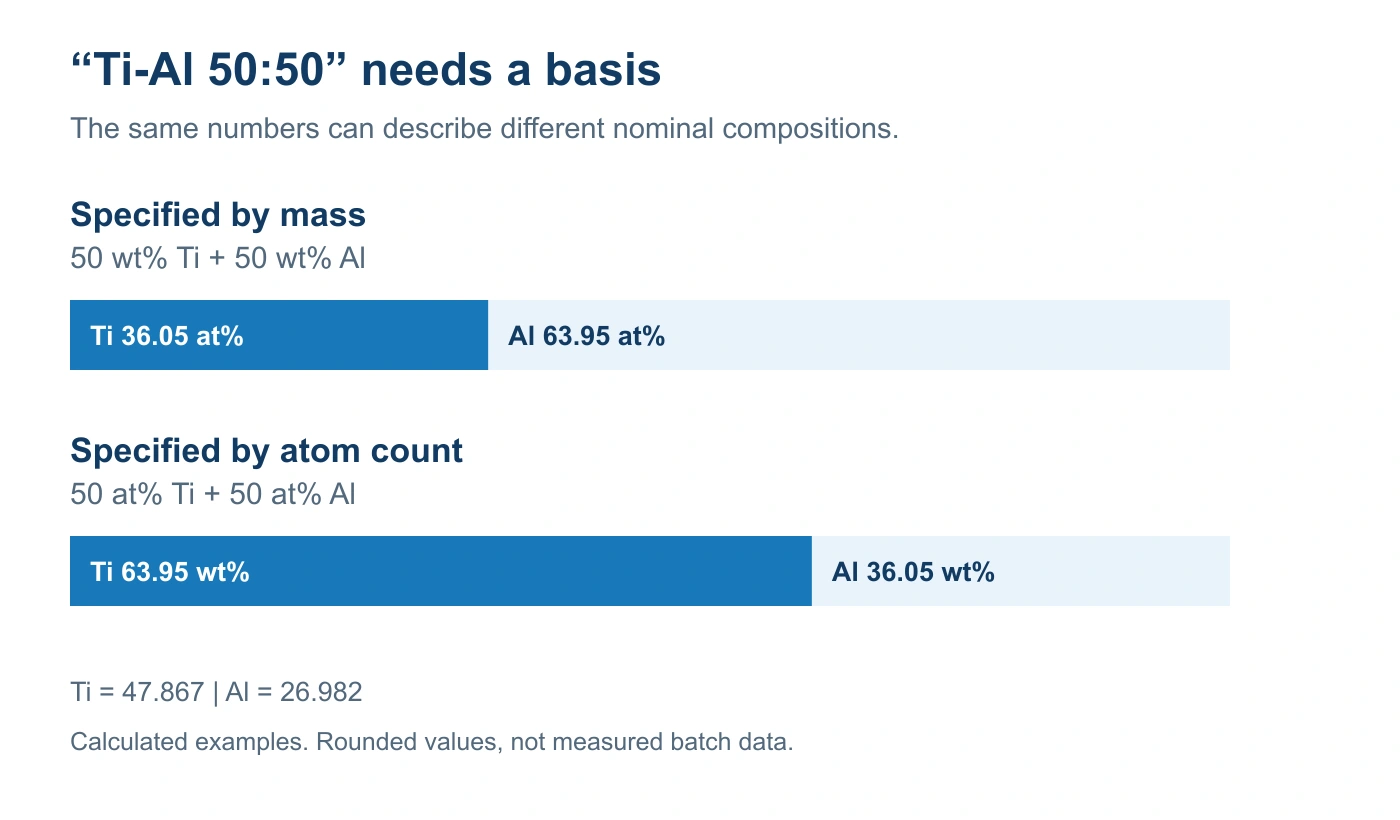
Using the CIAAW abridged atomic weights Ti = 47.867 and Al = 26.982, a 100 g mixture containing 50 g of each gives approximately 1.0446 mol Ti and 1.8531 mol Al. Normalizing these amounts gives 36.05 at% Ti and 63.95 at% Al.
For the reverse conversion, multiply atomic fractions by their respective atomic weights and normalize:
wᵢ = (xᵢ × Mᵢ) / Σⱼ(xⱼ × Mⱼ)
A target specified as 50 at% Ti and 50 at% Al therefore corresponds to approximately 63.95 wt% Ti and 36.05 wt% Al. Both specifications can legitimately be called “50:50,” but they are different nominal compositions. Neither calculation establishes the phases, homogeneity or sputtering behavior of a finished target.
The same calculation applies to three or more elements: include every specified constituent in the denominator. Keep additional digits during calculation and round only the final reported values. If trace constituents are omitted from a simplified comparison, state that exclusion. For material-family options, see MetalsTek’s titanium sputtering targets; any requested alloy composition still needs project-specific review.
Oxide targets: define what the ratio counts
For a compound target, “90:10” may describe oxide masses, oxide formula-unit amounts, or metal atoms. Write the component names beside the values. “In₂O₃:SnO₂ = 90:10 wt%” and “In:Sn = 90:10 at%, metals basis” specify different nominal chemistries.
Worked example: a nominal 90:10 oxide mass ratio
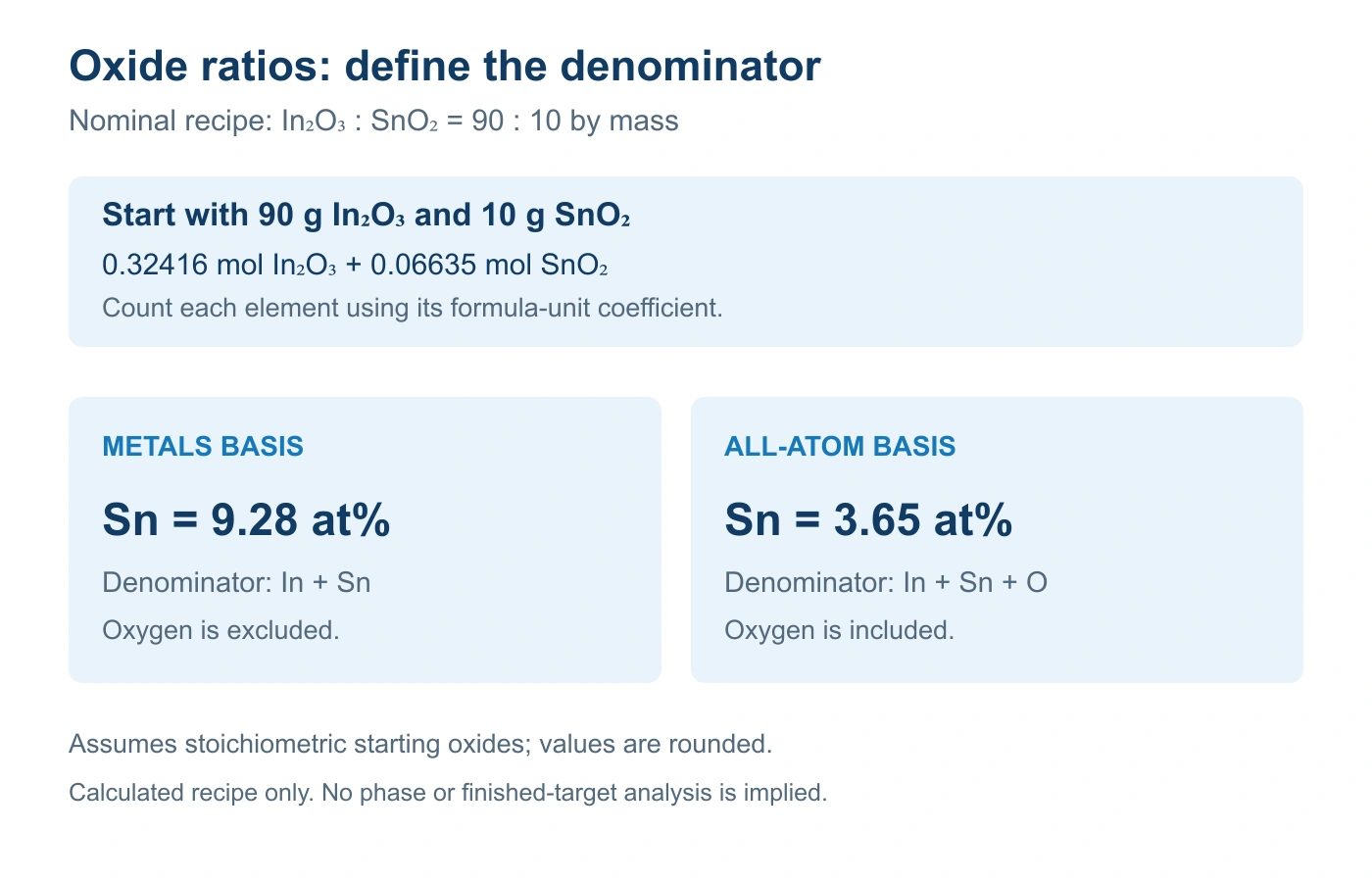
Consider 90 g In₂O₃ plus 10 g SnO₂, assuming stoichiometric starting oxides. Using In = 114.82, Sn = 118.71 and O = 15.999 gives formula molar masses of 277.637 g/mol for In₂O₃ and 150.708 g/mol for SnO₂. The mixture contains approximately 0.32416 mol In₂O₃ and 0.06635 mol SnO₂.
Count two indium atoms per In₂O₃ formula unit and one tin atom per SnO₂ formula unit. The nominal tin fraction among metal cations is therefore 0.06635 / (2 × 0.32416 + 0.06635), or about 9.28 at%. Include oxygen atoms in the denominator instead, and the nominal tin fraction is about 3.65 at% of all atoms.
These numbers describe the arithmetic of the stated recipe. They do not prove that a sintered target retains ideal oxygen stoichiometry or forms a particular phase. The requested ratio, the finished-material acceptance criteria and the analytical reporting basis should be agreed separately. MetalsTek’s indium and indium-compound target options provide relevant product context.
Keep composition, purity and verification separate
An alloy ratio describes intentional constituents. A purity requirement controls unwanted constituents under an agreed definition. “Ti-Al 50:50 at%” does not specify impurity limits, and “99.99% purity” does not explain an alloy’s Ti:Al ratio. For a ceramic, clarify whether a quoted purity is reported on a metals basis and how oxygen or other intended nonmetals are treated.
A useful purchase specification also states whether the composition is a starting-recipe target or an acceptance requirement for the finished material. Define tolerances on the chosen basis. An allowed interval in wt% converts into its corresponding interval in at%; copying the same numerical “±” value across the two bases is generally incorrect. Relative percent and percentage points also need to be distinguished.
Before ordering, agree what evidence is required. A bulk-composition result and a local surface measurement answer different questions. Ask which elements the method reports, how the values are normalized, whether oxygen is included, and whether the result applies to the supplied batch. A calculated conversion is not a substitute for a measured certificate of analysis.
Write an RFQ that preserves the intended recipe
Start with the material system and the composition basis, then add the physical and documentation requirements. Include:
- Every intended element or compound, with its nominal value and explicit wt%, at% or mol% basis.
- The normalization set: all elements, metals only, or named oxide formula units.
- Composition tolerances, purity definition, critical impurity limits and required verification.
- Target dimensions, drawing revision, quantity, backing plate and bonding requirements.
- The intended deposition process and any existing approved material specification.
For example: “Please review a Ti-Al target with nominal Ti:Al = 50:50 at%, normalized to Ti + Al. Quote against the attached drawing and quantity. Confirm achievable composition tolerances and propose batch-composition documentation before order placement.” This is a request for technical review, not a statement that the illustrated composition is stocked or already qualified.
Keep geometry and assembly requirements alongside chemistry. The sputtering targets hub covers available material families, while target bonding and rebonding services address backing-plate and assembly review. A correct composition cannot compensate for an incompatible mounting arrangement.
Frequently asked questions
Is at% the same as mol%?
Only when the stated entities and normalization set match. Moles of elemental atoms give the same numerical fractions as atom counts. Moles of compound formula units require the atoms in each formula unit to be counted before reporting atomic percent.
Can I convert wt% using density?
Density is not required for converting elemental wt% to at%. Use atomic weights. Density relates mass to volume; a volume-fraction specification is a different problem and must account for the material system and assumptions.
Does a 90:10 ITO ratio mean 10 at% tin?
Not without a stated basis. A nominal In₂O₃:SnO₂ ratio of 90:10 by mass corresponds to approximately 9.28 at% Sn among the metal cations under the assumptions above. A 10 at% Sn metals-basis specification describes a different recipe.
Does the target ratio guarantee the deposited film ratio?
No. A composition conversion describes the source material on a different reporting basis. It does not model the deposition process or verify the film. Specify the intended film separately and validate its composition under the actual process conditions.
What should I do if an old drawing only says 50:50?
Ask the drawing owner to confirm the basis and issue a controlled clarification. Check the approved material specification and previous accepted batch documents. Do not silently choose wt% or at% during a reorder.
Request a custom target composition review
Send MetalsTek your composition, reporting basis, tolerances and target drawing, together with quantity and documentation requirements. If the recipe uses oxide ratios or a metals-only normalization, include that wording explicitly so the quotation can address the intended material.