
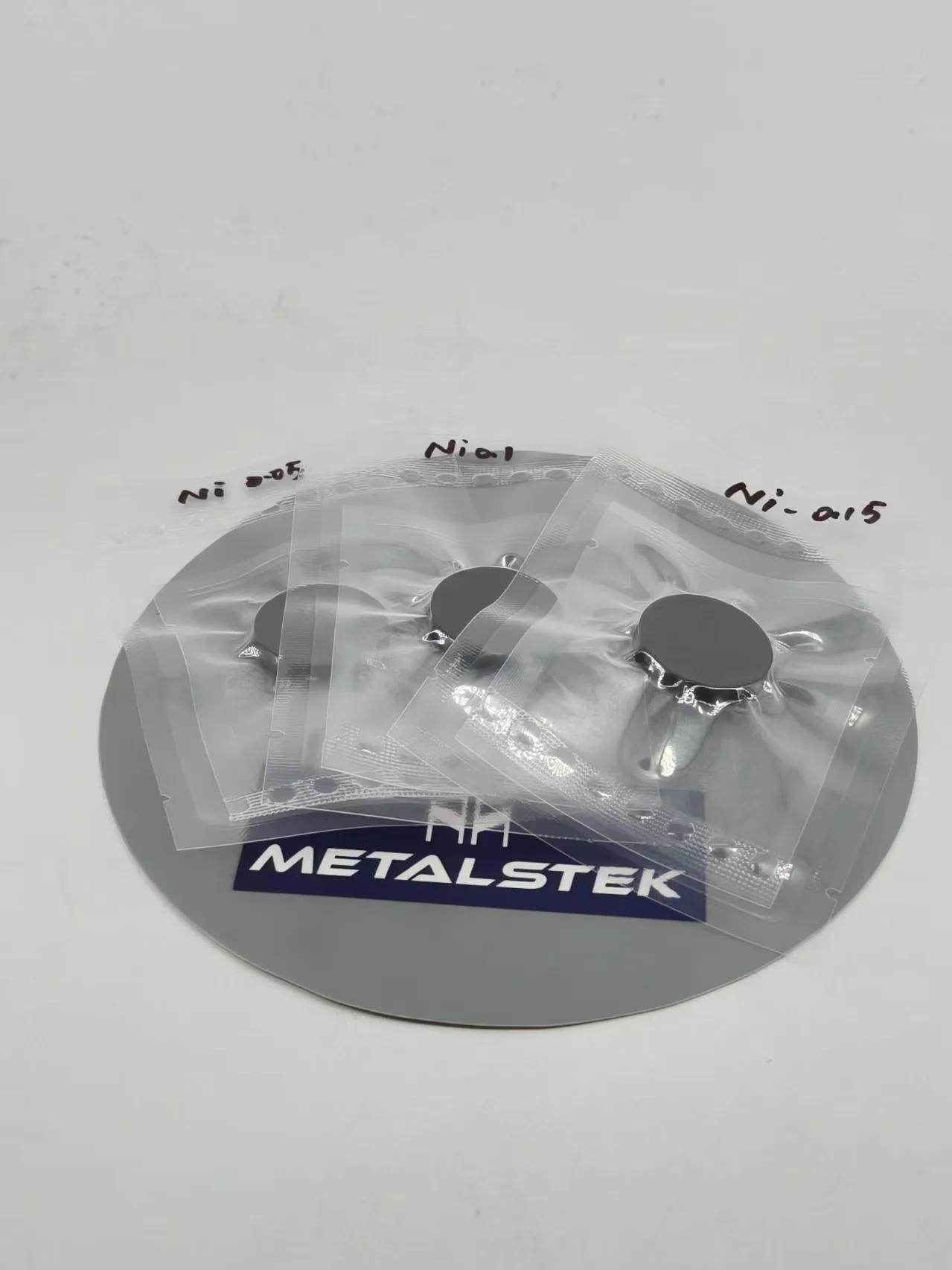
MetalsTek completed and shipped three Lu-based oxide formulations with different transition-metal ratios, all specified as Ø25.4 × 5 mm sputtering targets.
Project background: three formulations in one order
MetalsTek recently completed production and shipment of three formulations of custom multicomponent oxide sputtering targets. Each formulation combined lutetium with nickel, cobalt, iron, manganese, chromium, and oxygen. The order specified a purity requirement of 99.99% and a disc size of Ø25.4 × 5 mm for all three compositions.
Two formulations were manganese-rich; the third was strongly iron-rich. All shared the same nominal dimensions, allowing researchers to compare compositions in a common target format. The customer’s experimental program and results are not reported here.
The order is an example of custom composition work within MetalsTek’s sputtering target range. The manufacturing considerations discussed below apply generally to these materials. They should not be read as verified production procedures or test results for this shipment.
Order specifications
| Product | Specified nominal composition | Purity requirement | Dimensions |
|---|---|---|---|
| 1 | Lu(Ni0.1Co0.1Fe0.1Mn0.6Cr0.1)O3 | 99.99% | Ø25.4 × 5 mm |
| 2 | Lu(Ni0.15Co0.15Fe0.15Mn0.4Cr0.15)O3 | 99.99% | Ø25.4 × 5 mm |
| 3 | Lu(Ni0.05Co0.05Fe0.8Mn0.05Cr0.05)O3 | 99.99% | Ø25.4 × 5 mm |
Dimensions are diameter × thickness. Production and shipment are complete for all three formulations. The 99.99% figure is the order’s specified purity requirement, not a measured value reported in this case study.
There are seven elements in each formula: six metals plus oxygen. The Ni, Co, Fe, Mn, and Cr coefficients sum to 1.00 in every formulation. Lu remains at a nominal coefficient of one, while O3 records the requested formula rather than a measured oxygen content.
How the three compositions differ
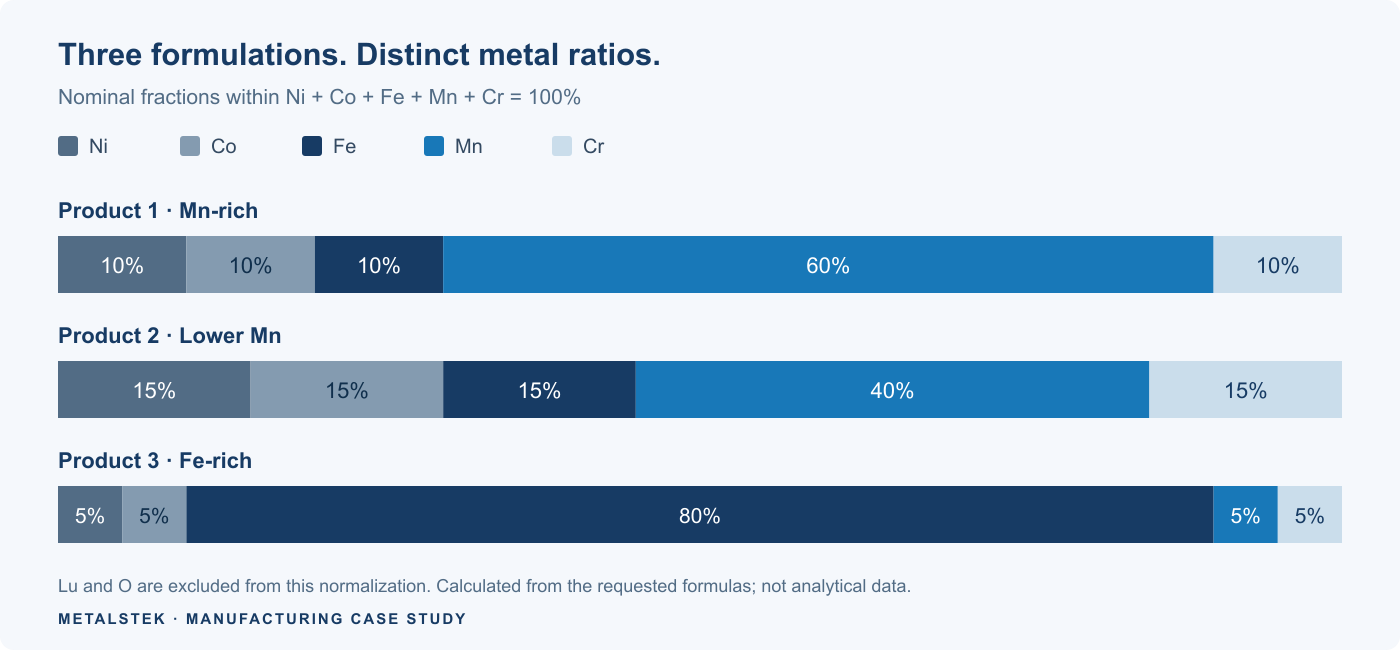
Product 1: the more Mn-rich formulation
Manganese accounts for 60% of the five-metal group in Product 1, making it the dominant component. Nickel, cobalt, iron, and chromium each account for 10%.
Product 2: less Mn, more of the other metals
Product 2 reduces manganese to 40% and raises each of the other four fractions to 15%. It remains Mn-rich within the five-metal group, but distributes the composition more evenly than Product 1. It is not an equimolar formulation.
Product 3: a strongly Fe-rich formulation
Iron accounts for 80% of the group in Product 3; the remaining four elements each contribute 5%. Researchers can use differences of this scale to investigate relationships between composition, structure, and properties. The formulas alone do not establish how these targets or their deposited films will behave.
Manufacturing challenges behind a complex formula
Converting metal ratios into a powder batch
Preparing a powder batch starts with converting the required metal amounts into precursor quantities. That calculation uses the selected compounds’ stoichiometry, molar masses, and relevant assay information. The oxygen contained in the precursors must also be accounted for separately from the intended metal ratios.
In Product 3, each minor component accounts for just 5% of the five-metal group. A weighing error can be substantial relative to that intended amount without noticeably changing the total batch mass. Buyers therefore need to specify acceptable deviations in metal ratios separately from the purity requirement.
Achieving local homogeneity
For complex oxide sputtering targets, correct total quantities do not guarantee uniform distribution. Differences in particle size, agglomeration, or mixing behavior can leave local regions enriched in particular constituents. Powder preparation must address these possibilities while limiting contamination introduced by processing equipment or handling.
Bulk chemical analysis and spatially resolved measurements answer different questions: one assesses overall composition; the other examines local variation. Neither should be inferred from a photograph or from the starting recipe. No homogeneity measurement is presented for this order.
Controlling phase formation and oxygen chemistry
With several metal species present, a thermal treatment may involve intermediate compounds or competing phases. Precursor selection, reaction kinetics, atmosphere, and thermal history can all affect the outcome. Published research on multicomponent oxide synthesis illustrates why selecting starting materials is itself an important design decision.
The requested Lu(…)O3 notation does not prove a single-phase perovskite structure. Crystal structure and phase constitution require characterization. Oxidation states and oxygen nonstoichiometry can also affect charge balance and material behavior, so the required characterization should be agreed before production.
For example, if Lu is trivalent and oxygen is present as O2−, charge balance in the nominal formula requires an average charge of +3 across the five-metal group. This calculation checks the formula’s internal consistency. It cannot assign an oxidation state to each element or establish how the atoms are arranged.
Balancing densification and dimensional requirements
For ceramic targets generally, consolidation must balance densification with grain growth, residual porosity, shrinkage, and cracking risk. A small disc still needs suitable geometry and surface condition for its intended mounting arrangement. Diameter, thickness, tolerances, and any backing-plate requirements should be reviewed together.
The exact forming route, sintering schedule, achieved density, and inspection methods used for this shipment are not specified here. Those details should come from the relevant manufacturing and quality records, rather than being assumed from the finished dimensions.
Custom manufacturing and delivery
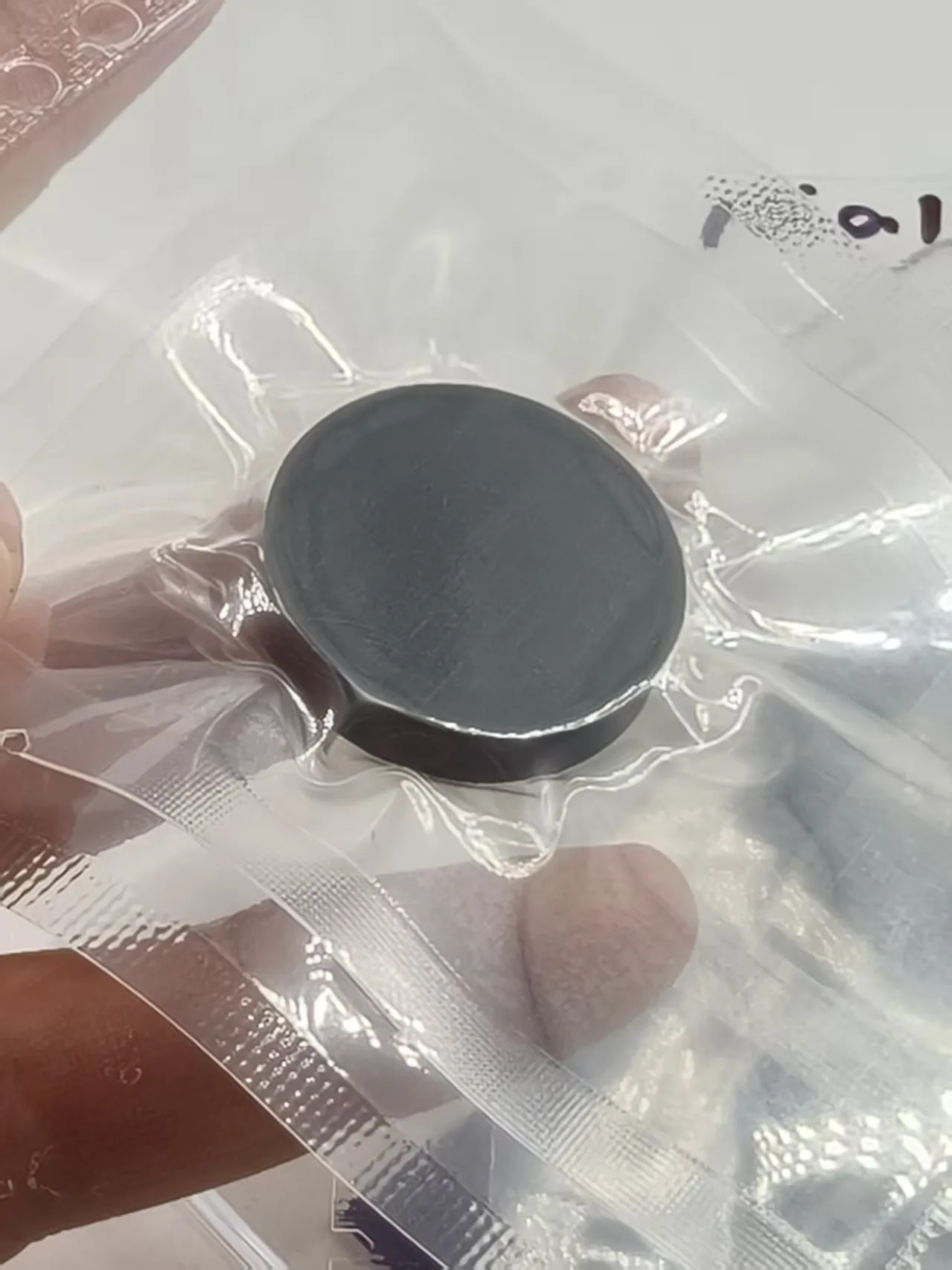
MetalsTek completed and shipped all three formulations in the requested nominal format. The order documents the supply of custom complex oxide compositions beyond the company’s standard catalog chemistries.
Researchers planning a small-batch program may need several composition variants at a common size, each intended to test a different materials hypothesis. This set of Lu-based oxide sputtering targets is an example of the type of request that can be submitted for manufacturing review.
New projects still need their own feasibility review. Quantity, composition tolerance, impurity limits, required characterization, and mounting details affect what can be offered. Where an assembly is needed, target bonding services and OFHC copper backing plates can be discussed separately. Bonding is not claimed as part of this shipment.
For procurement, define what “research-grade” means for your experiment. You may need limits on specific contaminants, a composition report, a phase-analysis report, or a defined dimensional tolerance. Request each deliverable explicitly during quotation. If purity is quoted on a metals basis, state that basis; intended oxygen should not be treated as an impurity. Agree on the supporting records before placing the order.
Potential use in functional oxide thin-film research
Changing transition-metal proportions offers a way to investigate how chemistry relates to phase development and properties in oxide films. Potential research questions include magnetic response, electrical transport, dielectric behavior, and sensitivity to oxygen conditions. These are possible directions for investigation, not demonstrated applications or customer results for the three formulations.
A composition series can help organize such comparisons, but a target formula is not a guarantee of deposited-film composition. Preferential sputtering and deposition conditions may alter the transfer of constituents. Studies of oxide mixture sputtering examine preferential sputtering effects. Film composition and structure should be assessed independently.
Researchers considering other compound chemistries can also review MetalsTek’s potassium niobate sputtering target. It is a separate material option, not a substitute for these Lu-based formulations.
Technical FAQ
Are these high-entropy oxide targets?
This case uses the broader term “multicomponent oxides.” Counting elements alone does not establish a high-entropy classification or entropy stabilization. The formulas are non-equimolar, and their phase structures and site occupancies are not established here. Foundational entropy-stabilized oxide research relied on experimental evidence, not elemental count alone.
Does 99.99% mean the metal ratios are accurate to 0.01%?
No. Purity and composition tolerance are different specifications. Here, 99.99% is the requested purity requirement; it is not a reported assay. The basis of purity, impurity limits, and acceptable deviations in individual metal ratios should be agreed separately.
Does the O3 formula confirm a single-phase perovskite?
No. Nominal stoichiometry does not identify crystal structure or rule out secondary phases. Phase analysis, such as X-ray diffraction, would be needed to support a structural claim. No such result is reported for this shipment.
Can a custom target reproduce the same composition in a film?
That must be established under the user’s deposition conditions. Target composition, sputtering behavior, oxygen conditions, and substrate processing can influence the film. A desired film formula should be included in the RFQ, alongside the proposed target formula.
What is needed to quote a similar research order?
Send the complete formula, quantity per composition, dimensions and tolerances, purity basis, required tests, and delivery destination. Include the sputtering system or mounting drawing and any backing-plate requirement. If some parameters are still open, identify them so feasibility and documentation can be discussed.
Need custom multicomponent oxide sputtering targets?
Send MetalsTek your proposed compositions and target specifications for review. We can assess requests for custom ceramic sputtering targets with tailored stoichiometry, including Mn-rich or Fe-rich variants and other complex oxide systems.
Include quantity per formula, dimensions, tolerances, purity requirements, requested characterization, mounting details, and delivery needs.